Snickerdoodle Blondies

Snickerdoodle Blondies | marissabaker.wordpress.comI tried a couple recipes for snickerdoodle bars or blondies before finding this one from Six Sisters Stuff. It’s so good! I still prefer the actual snickerdoodle cookies, but this is a very tasty bar form that takes much less time to make since the dough doesn’t need chilled and you bake the whole thing at once.

Snickerdoodle Blondies

Snickerdoodle Blondies | marissabaker.wordpress.com1 cup butter, room temperature

2 cups packed brown sugar

2 eggs

1 Tablespoon vanilla

2 2/3 cups flour

2 tsp baking powder

Topping

2 Tablespoon white sugar

2 teaspoon ground cinnamon

Combine the butter, brown sugar, eggs, and vanilla in a large bowl by hand or with an electric mixer. Stir in dry ingredients.

Snickerdoodle Blondies | marissabaker.wordpress.comSpread batter in a greased 13×9-inch baking pan. In a small bowl, mix the cinnamon topping ingredients, then sprinkle over the top of the batter.

Bake at 350°F for 25-30 minutes or until top springs back when pressed.

Snickerdoodle Blondies | marissabaker.wordpress.com

The Missing Disney Princesses

UPDATE 12/19/2016: Hello, all. I’ve heard your comments, re-watched films, and re-typed some princesses (and added Moana!). Click here to check out my brand-new updated Disney Princesses MBTI Chart.

You may have seen those images with a Myers-Briggs chart that matches up an MBTI type for each character in a series or film. I did one for Lord of the Rings, the Star Wars one was quite popular for a while, and I’ve seen others for Hunger Games and Downton Abbey, to name just a few. Another you might have seen features Disney princesses.

The problem with these types of charts is it assumes there’s an example of each of the 16 types available. Unfortunately, they’re not always so evenly represented (I had this problem trying to type people in Lord of the Rings — there’s an unusually high number of introverts). Since there’s only 13 “official” Disney princess (if you count Elsa and Anna, who haven’t been officially crowned yet), that makes it rather difficult to come up with 16 types. On top of that, there also seems to be certain personality types which make “better” princesses than others, so there is some overlap. All together, the 13 official princesses represent 11 different personality types:

An MBTI chart for Disney's official princesses. I’ll give descriptions of each type in a moment, along with a bit on why I think they fit each princess. But first, 13 princesses really isn’t that many — they couldn’t have filled out the chart even if there wasn’t any overlap. So let’s add a few of the “unofficial” princesses: Jane, Kida, Giselle, Megara, Nala, and Esmerelda. We’ve now added six more characters, but only filled in two more MBTI types.

An MBTI chart for Disney's official and unofficial princesses.

The “missing” princesses can be explained by the fact that the NF and NT types are less common in real life. The lack of ESTJs (with the possible exceptions of Jane and Kida) is explainable by Isabel Myer’s observation that it is “the most traditionally ‘masculine’ type.” But one of the reasons Disney has been pressured to introduce more racially diverse Princesses is that little girls should be able to see people like them represented in the stories they enjoy. But what about the little INTJ and INTP girls, who see very few positive portrayals of their personality type, especially as female characters? (I asked my INTJ sister if she could think of any female characters who she identifies with as a similar personality and the only one she could come up with was  Dr. Temperance Brennan from Bones.)

Looking back at the chart of just the 13 official princesses, most of the missing personality types are thinkers: ESTJ, ENTJ, INTJ, and INTP. You could say that’s because most women are feeling types, but that’s a bit like saying most books are paperback instead of hardcover. There are more feeling-type women, but there are certainly plenty of thinking-type women as well. The only official Disney princesses who are thinking types right now are Jasmine, Mulan, Merida, and Tiana. The next Disney movie will feature their first Polynesian princess, Moana, and I think I would be awesome if she was also their first “official” princess who was an ESTJ, ENTJ, INTJ, or INTP. Or an ENFJ, since they’ve been left out, too.

Type Explanations for The Princesses

Disclaimer: typing fictional characters is a great way to stir-up disagreements, and it’s very rare that people agree on a typing. The types I’ve gone with for each character reflect my personal feelings, supported by reading other people’s thoughts on websites like personalitycafe.com and this excellent blog post. Please feel free to disagree, and let me know in the comments how you’d type these princesses 🙂

SJ types

The personality group that David Keirsey refereed to as “Guardians” is the best represented in this grouping of Disney characters. It’s really not surprising — they make good heroes and about 40 to 45 percent of the population falls into this group. SJ types are hardworking people who enjoy helping others and want to “do their duty.”

ESTJs are take-charge people who are practical, well-grounded, loyal and organized. They enjoy new experiences that appeal to their senses, such as meeting new people and traveling to a new place. They often ignore their intuition and base most of their decision on past experience. None of the official princesses fit this type, but Jane Porter from Tarzan and Kida from Atlantis might be ESTJs (honestly, I’m not sure, but I’m not sure where else to put them either).

The ISTJ is a very responsible type, and they are extremely hardworking. They value decisiveness and logic, with little time for make-believe or patience with other people’s oversights. Practical and fact-oriented, they are honest and dependable. Tiana from The Princess and the Frog is an ISTJ.

ESFJs are warm, friendly, and people-oriented. They value loyalty, friendship, and harmony. They are typically practical people with well-defined ideas that they aren’t afraid to share. Anna from Frozen is a very good example of this type, particularly in showing the strongly social side of ESFJs and their tendency to trust people quickly. Snow White is another example, and we could also add the “unofficial” princess Giselle, since she was patterned after Snow White’s personality.

ISFJs are as hardworking as ISTJs, but more interested in people than than in facts. They are very considerate, loyal, and will put up with quite a bit of abuse before provoking a conflict. ISFJs aren’t likely to express their inner ideas and feelings except with close friends. Cinderella is a good example of this type.

SP types

Keirsey called the SP types “Artisans,” because they work well with solid objects — whether it’s a weapon or a paintbrush. This group of personality types focuses on the now, and tends to be both fun-loving and realistic. 30 to 35 percent of the population fits in this group.

ESTPs like to take action — they don’t enjoy sitting around and waiting for something to happen. They are realistic, adaptable, and enjoy physical activities. In the case of Merida from Brave, this includes horseback riding and archery. They hate feeling confined, and are impatient with theories or ideas that they can’t see practical application for.

ISTP types are good with tasks that involve some kind of physical skill, and they like to take the time to think before acting so they can complete tasks in them most efficient way. They might seem aloof from other people, but do care about equality and fairness for groups and individuals. Mulan is an example of this type, and so is the “unofficial” princess Megara from Hercules.

ESFPs are friendly and focused on other people. They like observing as well as interacting with others, and have a powerful sense of curiosity. Material possessions interest them, and they often have some kind of a collection that they find ascetically pleasing. They hate structure and confinement as much as ESTPs. Ariel from The Little Mermaid is an excellent example of this type.

The ISFP type likes to work with people and meet their needs, but is generally quiet and reserved. Isabel Myer says they often “have a special love of nature and a sympathy for animals.” Like other SP types, they work well with their hands and are in tune with external sensory details (including things like music). Aurora from Sleeping Beauty is hard to type since she has so little screen-time, but she seems like an ISFP to me.

NF types

Types who rely on Intuition are more rare than Sensing types. The NF types who Keirsey called “Idealists” make up only 15 to 20 percent of the population. They are romantic, intuitive, spiritual, and seek good. Though their rarity in Disney is reflected by rarity in reality, it’s really surprising that this type isn’t more prevalent in fairy tale stories, especially since most NF types (though certainly not all) are women.

ENFJs are very social and have excellent people stills. They have a gift for expressing themselves and can influence other people (usually they have a very strong aversion to hurting others, but they have the potential to be manipulative). Typically honest and imaginative, they may hide their opinions in order to avoid disagreements and maintain harmony. None of the Disney princesses are ENFJs.

We finally got an INFJ Disney princess when Frozen was released last year (and I’ve already written about Elsa as an INFJ). This is the rarest personality type. INFJs are focused on their inner worlds of possibility and rely heavily on their intuition. They care deeply about other people, and avoid conflict as much as possible even if it means hiding their true self.

ENFPs are creative, imaginative, and artistic. They are easily excited by new ideas, but only follow through on pursuing the most important goals. Possibility excites them, and they love interacting with people and sharing their dreams and ideas. Rapunzel, sometimes typed as an ENFJ, is more typical of the ENFP type.

INFPs value internal harmony and have deep feelings that are rarely expressed to other people. They often seem like outsiders in their society and are more concerned with their inner moral code than with external expectations. Even so, they interact well with other people and are very loyal. Belle from Beauty and the Beast and Pocahontas are both examples of this type.

NT types

“Rationals,” as Keirsey described the NT types, are the rarest group — only 5 to 10 percent of the population. They are skeptical, analytical, and independent. Their rarity helps explain why there aren’t more Disney princesses in this category, along with the fact that most (though certainly not all) NT types are men.

ENTJs are problem-solvers who like to lead. They are curious about new possibilities, and enjoy theoretical problem solving as well as coming up with practical solutions for current problems. They are very forceful and decisive. None of the human princesses fit this type. Nala from The Lion King acts very much like an ENTJ, though, especially as an adult who leaves her pride to go off and find a solution to the problem of Scar.

The INTJ personality type is almost as rare as INFJs, and female INTJs are the rarest gender-type combination. They are often cast as villains in fiction, which is a shame because they make such wonderful scientists and detectives (like Basil of Bakerstreet from The Great Mouse Detective, to use Disney as an example [Update: after re-watching this film, I now type Basil as an INTP. Click here to read why]). INTJs are innovative, clever, and very organized. If something isn’t logically challenging, it rarely holds their interest.

ENTPs tend to be independent and a bit impersonal. They are more concerned with their projects and plans than with how those plans will affect other people. They don’t like routine, preferring new experiences that challenge their quick minds. ENTPs are versatile, clever, and enthusiastic about understanding their worlds. Jasmine and the “unofficial” princess Esmeralda are examples of this type.

INTPs are described by Isabel Myer as “the most intellectually profound of all the types.” They are curious, logical, easily bored, and focus on creating theory regardless of whether or not it has practical application. They often have trouble relating to people because they see little value in feelings and find it hard to explain their ideas in a way that makes sense non-experts. None of the Disney princesses fit this type.

Click to learn more about my upcoming INFJ e-book and contribute your story. Everyone whose stories are used in the book will receive a free copy once it is finished.

Save

Save

How Should We Think of Sin?

I wonder why it is that people tend to go to extremes in so many things. It’s almost impossible to be neutral or moderate on anything from politics to how you feel about a TV show without someone telling you that you have to have a decided opinion one way or another. This spills over into how we approach morality as well — we either go along with the culture and adopt an “anything goes” mentality, or we dig our heels in and don’t approve of anything.

Now, most Christians I know are actually a lot more balanced than either of these views, but there is a very real danger of going to either extreme. We can become too tolerant about something like the fact that cohabiting couples are the norm in pop culture, and just accept this trend in society  even though we know what God says about sexual immorality. People tend to go to extremes over the issue of homosexuality as well, either supporting it wholeheartedly or placing it high on their “most horrible disgusting sin ever” scale.

But is either view how God wants us to respond to sin? This is an enormous topic, and I might very well be biting off more than I can chew, as the saying goes. But it’s something I felt like I should study and share, so here it goes.

Sin in the Church

Let’s start with a very foundational principle of scripture: “all have sinned and fall short of the glory of God” (Rom. 3:23). There’s no “my sin is better than your sin,” because all of us have committed sins that could only be removed by the sacrifice of Jesus Christ. It can’t really get “worse” on the sinning scale than requiring God Himself to die to remove your death penalty.

But, again with our tendency to go to extremes, we might take this fact and become too accepting of sin in our lives and in the lives of others. After all, we’re no better or worse than anyone else, so let’s just all live and let live, right? That’s what the Corinthians did, and Paul wasn’t too happy about it.

It is actually reported that there is sexual immorality among you, and such sexual immorality as is not even named among the Gentiles—that a man has his father’s wife! And you are puffed up, and have not rather mourned, that he who has done this deed might be taken away from among you. … Your glorying is not good. Do you not know that a little leaven leavens the whole lump? (1 Cor. 5:1-2, 6)

They thought tolerance was a good thing. Paul said to get this sinful man out of the church.

I wrote to you in my epistle not to keep company with sexually immoral people. Yet I certainly did not mean with the sexually immoral people of this world, or with the covetous, or extortioners, or idolaters, since then you would need to go out of the world. But now I have written to you not to keep company with anyone named a brother, who is sexually immoral, or covetous, or an idolater, or a reviler, or a drunkard, or an extortioner—not even to eat with such a person. For what have I to do with judging those also who are outside? Do you not judge those who are inside? But those who are outside God judges. Therefore “put away from yourselves the evil person.” (1 Cor. 5:9-13)

The issue here is that we cannot approve of someone who knowingly practices sin while professing to follow Christ. The people outside the church who commit sin are still sinning, but it is not our place to make judgements about them. The people inside the church should know better, though, and so should we.

Woe to those who call evil good, and good evil; who put darkness for light, and light for darkness; who put bitter for sweet, and sweet for bitter! (Is. 5:20)

Christians are not immune to sin, but there is a difference between a Christian who sins, recognizes it, repents, and stops sinning and a Christian who knowingly practices a sinful lifestyle. The latter reflects badly on the One we profess to follow, Jesus Christ, Who said, “If you love Me, keep My commandments” (John 14:15). Paul tells us this type of person who practices sin should be put out of the church until they repent and stop sinning (which did happen in this case, as we can read in 2 Cor. 2:5-11).

A Chance to Be Good

Paul instructed us to exercise good judgement within the church, but not to judge those who are outside it. So what should our attitude be towards those who commit sin while not following Christ?

In answering any question of this sort, the first thing we should look at is the example of Jesus Christ. He was God in the flesh, and the way He responded to a situation shows us how God wants us to respond in similar situations.

And the Pharisees and scribes complained, saying, “This Man receives sinners and eats with them.”

So He spoke this parable to them, saying: “What man of you, having a hundred sheep, if he loses one of them, does not leave the ninety-nine in the wilderness, and go after the one which is lost until he finds it? And when he has found it, he lays it on his shoulders, rejoicing. And when he comes home, he calls together his friends and neighbors, saying to them, ‘Rejoice with me, for I have found my sheep which was lost!’ I say to you that likewise there will be more joy in heaven over one sinner who repents than over ninety-nine just persons who need no repentance.” (Luke 15:2-7)

How Should We Think of Sin? | marissabaker.wordpress.comThe scribes and Pharisees had a very “holier-than-thou” attitude toward sinners. They despised Jesus for eating with people who were not considered righteous and rebuked Him for letting them touch Him (Luke 7:37-39). We get the sense that if a Pharisee encountered someone they thought of as a sinner, they would have either had nothing to do with them or been harsh in their condemnation of how horribly sinful this person was. But that’s not how Christ handled things.

When “the scribes and Pharisees brought to Him a woman caught in adultery,” Christ’s response was to write on the ground and then say, “He who is without sin among you, let him throw a stone at her first.” They all left one by one, and when there was no one left to accuse her Jesus said, “Neither do I condemn you; go and sin no more” (John 8:1-11). He did not condone her sin by telling her she could go off and continue committing adultery, but neither did He condemn her as a person.

Now it happened, as Jesus sat at the table in the house, that behold, many tax collectors and sinners came and sat down with Him and His disciples. And when the Pharisees saw it, they said to His disciples, “Why does your Teacher eat with tax collectors and sinners?”

When Jesus heard that, He said to them, “Those who are well have no need of a physician, but those who are sick. But go and learn what this means: ‘I desire mercy and not sacrifice.’ For I did not come to call the righteous, but sinners, to repentance.” (Matt. 9:10-13)

We’re not supposed to be okay with sin or say that it is good, but the key to what our response should be is mercy and love. That is how Christ called people to repentance — not by telling them they were evil, but by offering them a chance to be good.

Making Judgements

The goal of Christ’s interactions with sinful people was that all should come to repentance. The goal of our interactions with sinful people (so, really everyone we come in contact with) should be to point them to Christ by modeling His attitude of love, mercy, and gentle correction when necessary.

Judge not, that you be not judged. For with what judgment you judge, you will be judged; and with the measure you use, it will be measured back to you. And why do you look at the speck in your brother’s eye, but do not consider the plank in your own eye? (Matt. 7:1-3)

We saw how harshly the Pharisees judged other people, and we can see how severely they were judged in return by reading Matthew chapter 23. It serves as a warning to us not to judge others from a self-righteous attitude. We do have to make judgements about right and wrong as relates to our own conduct and in situations like Paul was talking about in 1 Corinthians, but we need not be harsh and condemning. In fact, that attitude can be dangerous.

Therefore you are inexcusable, O man, whoever you are who judge, for in whatever you judge another you condemn yourself; for you who judge practice the same things. (Rom. 2:1)

The context of this verse (Rom. 1:18-2:16) discusses some of what we think of as the very worst sins. That might make us think this warning doesn’t apply to us, until we read James.

For whoever shall keep the whole law, and yet stumble in one point, he is guilty of all. For He who said, “Do not commit adultery,” also said, “Do not murder.” Now if you do not commit adultery, but you do murder, you have become a transgressor of the law. So speak and so do as those who will be judged by the law of liberty. For judgment is without mercy to the one who has shown no mercy. Mercy triumphs over judgment. (James 2:10-13)

I’ve heard it said that we can’t judge other people for sinning differently than us, and I think that’s true. We all have weaknesses, and we’re not supposed to decide that they are better weaknesses than someone else, even if they’re less visible (like, a tendency to lie can be less visible than a tendency towards promiscuity) or seem like they’re “not hurting anyone.”How Should We Think of Sin? | marissabaker.wordpress.com

We’ve now made a full circle in our discussion, and are back to the topic of “all have sinned.” I said earlier that all sins are equally bad, because all sins require Jesus Christ’s death to pay the penalty on our behalf. I want to add something to that, though, because I’ve never felt satisfied with such a black-and-white view of sin. It’s obvious that there’s a difference between petty theft and murder, for instance. Both are against God’s laws, both are sins, and both can only be washed clean by Christ’s blood. But one is far more damaging to society and other people.

We can see God acknowledging this in the Old Testament laws, where some sins incurred a physical death penalty and some did not. In the New Testament, we see similar distinctions. A thief is told to “steal no longer,” but rather work “with his hands what is good, that he may have something to give him who has need” (Eph. 4:28). In contrast, those who commit sexual transgressions are warned, “he who commits sexual immorality sins against his own body” and defiles the temple of God (1 Cor. 6:18-20). Both are sinful, but one causes more damage than the other.

As we consider the topic of sin inside and outside the church, let’s keep our focus on following Christ’s example of showing mercy while faithfully revealing God’s laws in our words and actions. We must not “approve of those who practice” sin (Rom. 1:32), but we also must not hate other people or follow the scribes and Pharisees’ example of harsh judgement.

Crunchy No-Bake Cookies

Crunchy No-Bake Cookies | marissabaker.wordpress.com

I have perfected the no-bake cookie!

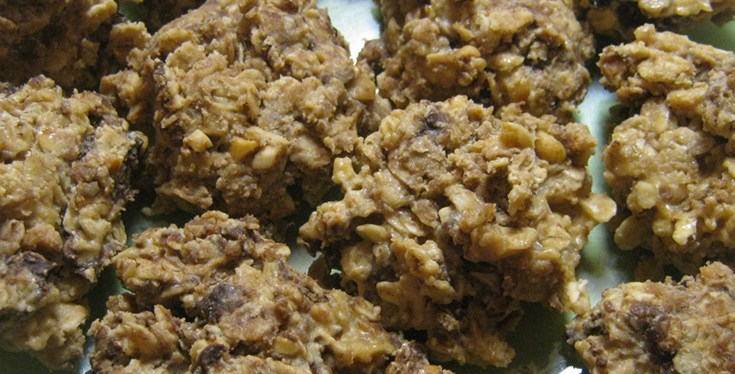
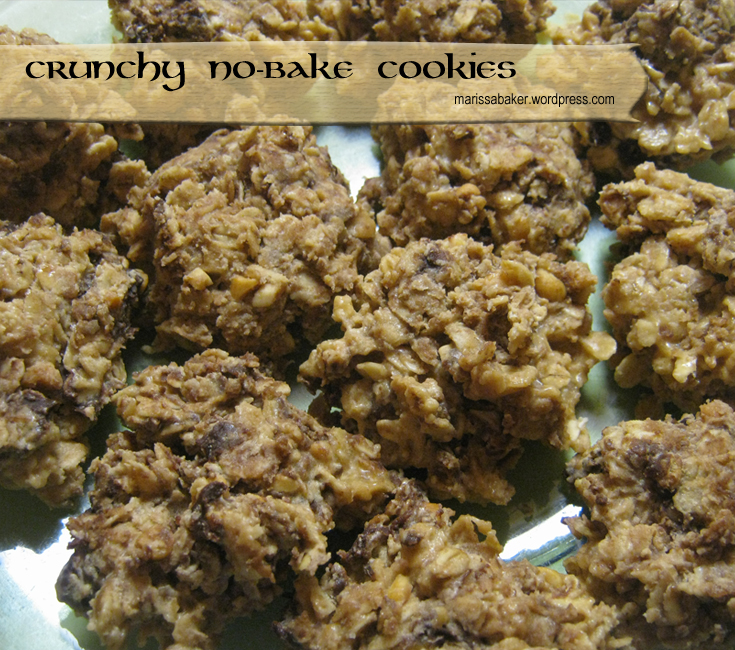
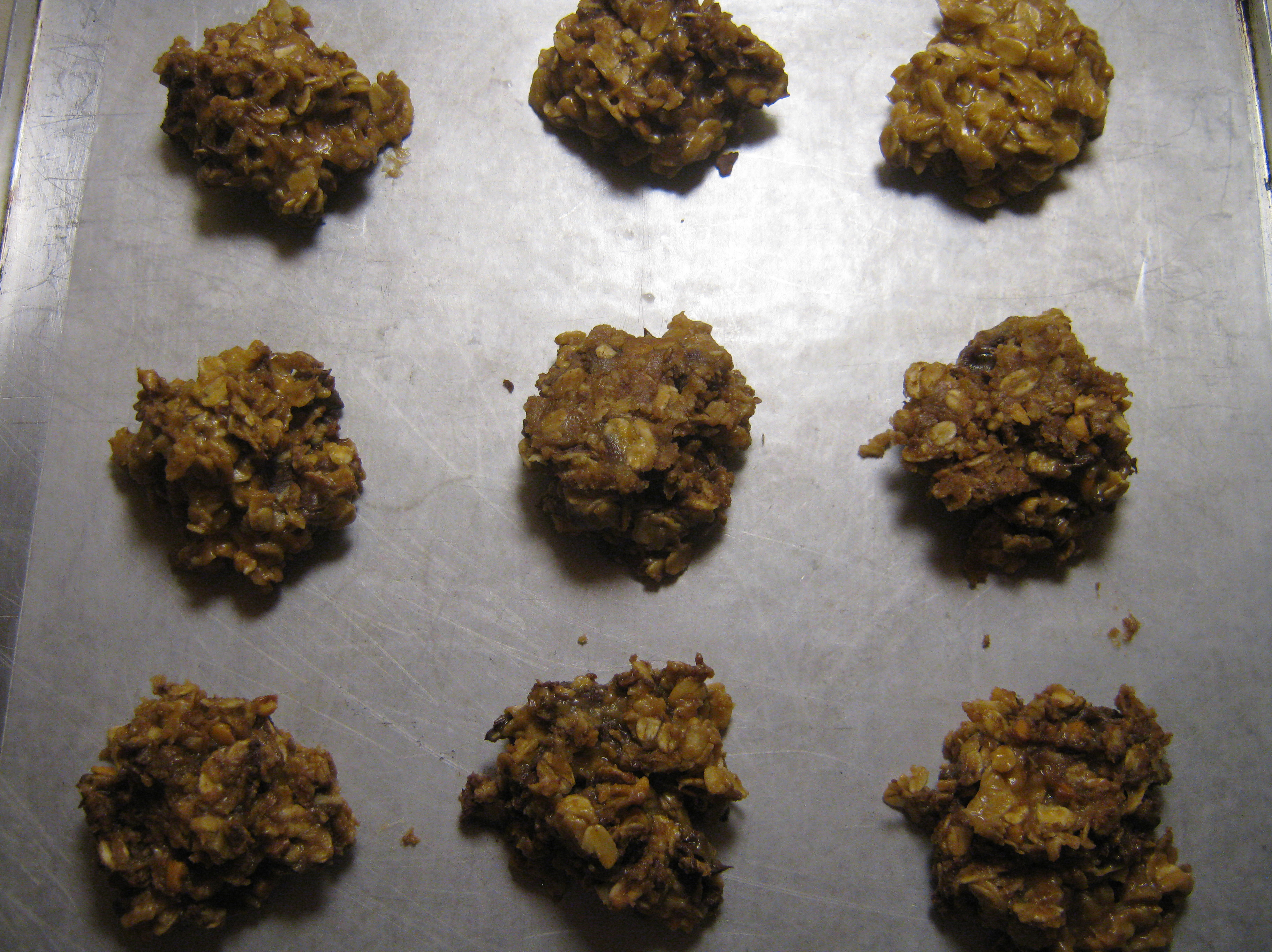
Okay, perhaps that is a bit of an exaggeration, but these are seriously good. My previous no-bake recipe (a rather standard one using cocoa powder) typically resulted in a sticky, fudge-like mess that tasted good but wasn’t much like a cookie. These are more substantial, and hold their cookie shape once they’ve set.

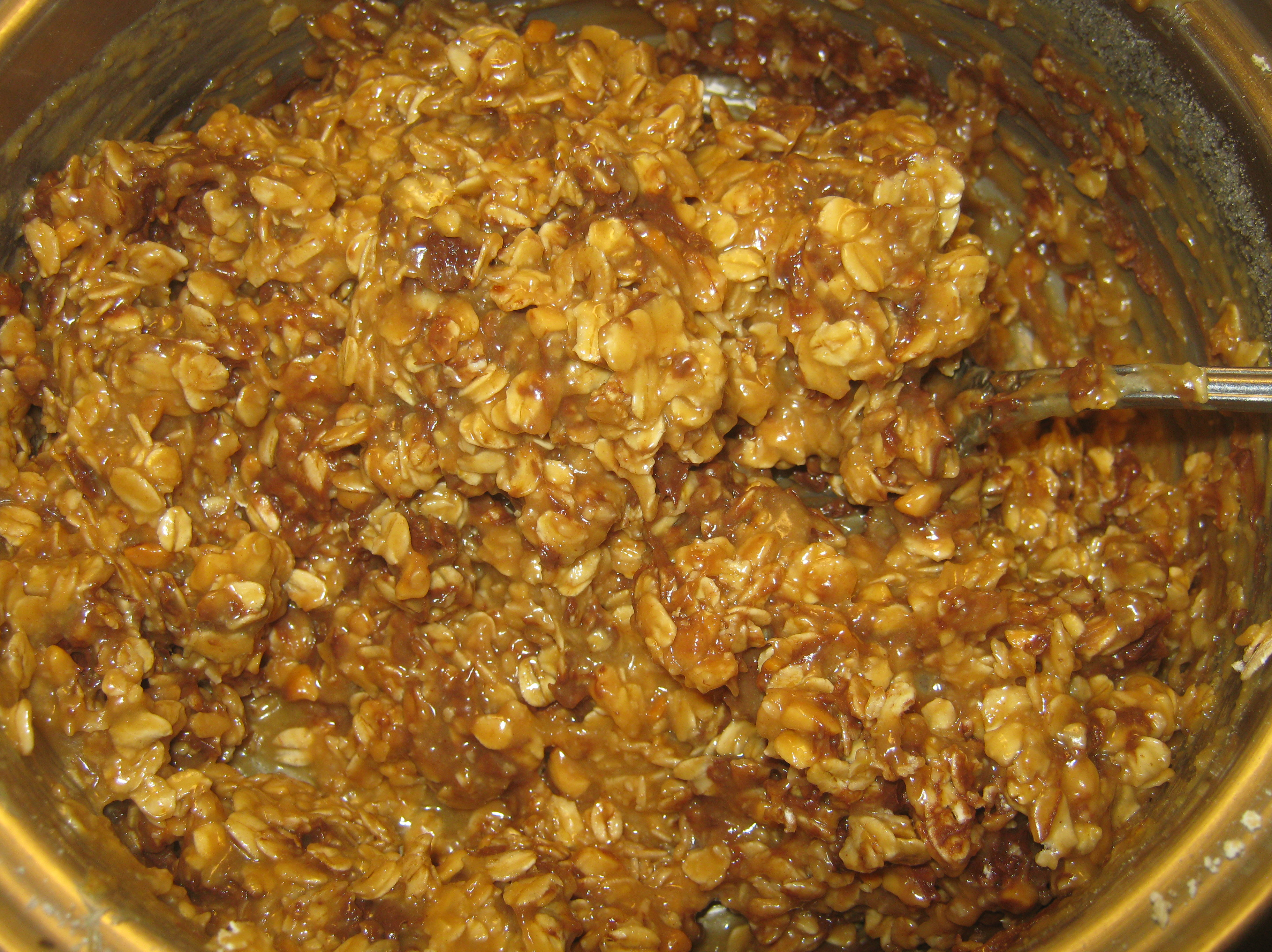
You could make it with creamy peanut butter, but I prefer having the crunchy peanut pieces. That’s also the reason I use full-size chocolate chips — they’re large enough not to melt completely, so there are chunks of chocolate in the finished cookie. If you’d rather have the chocolate all melted in, just stir it longer or use mini chocolate chips.

Crunchy No-Bake Cookies

Crunchy No-Bake Cookies | marissabaker.wordpress.com2 cups sugar

1/2 cup milk

1/4 cup butter

1 cup crunchy peanut butter

3 cups rolled oats

1 teaspoon vanilla

1 cup semi-sweet chocolate chips

Combine sugar, milk, butter, and crunchy peanut butter in a large sauce pan. Bring to a boil over medium-high heat. As soon as the mixture boils, remove from heat.

Crunchy No-Bake Cookies | marissabaker.wordpress.com

Stir in vanilla and oats. Add chocolate chips and stir just long enough to mix them in, but not long enough to completely melt the chips. Drop from a spoon onto cookie sheets covered with wax paper. Chill and serve.

Crunchy No-Bake Cookies | marissabaker.wordpress.com

Thoughts On The New Doctor

I started watching Doctor Who a few years after “new Who” started, beginning with Eccleston and continuing on in order. I liked Nine, but fell in love with Ten. Even though I was still catching up at that point, knew it was coming, and had Matt Smith episodes that I could watch, I went into mourning for a month after he regenerated and refused to watch any of Eleven’s episodes. But I finally did, and I liked him almost instantly.

And then just a few years later he left. By that time I’d caught up with all the episodes, so there wasn’t the assurance of knowing who’d replace him. It was, in many ways, more traumatic than David Tennant leaving because on top of losing a Doctor I loved, I didn’t know who might replace him. It could have been anyone — a woman, an American (the Horror!), a non-Whovian …

… and then it was Peter Capaldi, and I stopped freaking out. That’s when some of my friends started freaking out, though — he’s too old and too grumpy and shouldn’t be trusted with our favorite character. But I had a good feeling about him for some reason.

SPOILER WARNING

I think I was right. It takes a while the first episode after the Doctor regenerates for him to settle into a personality, and he flitted through a few of the old ones before we got a good sense of who he’ll be now (including asking for a very long scarf and screaming “Geronimo”). Still, I think I’m going to like the Doctor this way. And I have very, very high hopes for the upcoming “Robot of Sherwood” episode (I’m a bit obsessed with Robin Hood legends. Actually Medieval things in general).

There’s plenty of in-depth reviews already, so I’ll just touch on a couple things I though were of note …

Steampunk title sequence! Last time they changed the title and music I was upset, but this time I liked it. I suppose the gears are actually supposed to make me think of time and watches rather than steampunk, but who cares — it was cool. Like bow ties.

The cameo appearance of Matt Smith might not have been surprising for some people, but it was for me. And it was splendid. Clara needed it, and I think some of Matt’s fans probably did, too. *cue sobbing*

“Girl In The Fireplace” is my favorite episode, so I loved the parallels here. Well, “loved” in the sense that I liked how it reminded me of this episode even though robots harvesting human beings for spare parts is bloody creepy.

Clara was splendid. There have been rumors floating around that Jenna Coleman will be leaving in the Christmas episode, and I really hope that’s not true. I’ve liked her as a companion, and I like her even more after seeing her stand up to Madam Vastra and try to convince The Doctor that she’s not an egomaniac by shouting “Nothing is more important than my egomania!”

One of my favorite scenes is where the Doctor is talking with a homeless man (didn’t catch his name, but planetclaire.org says it’s Barney) about his new face.

The Doctor: Why this one? Why did I choose this face? It’s like I’m trying to tell myself something. Like I’m trying to make a point. But what is so important that I can’t just tell myself what I’m thinking? I’m not just being rhetorical here. You can join in.
Barney: I don’t like it.
The Doctor: What?
Barney: Your face.
The Doctor: Well I don’t like it either. I mean it’s alright up to the eyebrows. Then it just goes haywire. Look at the eyebrows! These are attack eyebrows. You could take bottle caps off with these.
Barney: They are mighty eyebrows indeed sir.
The Doctor: They’re cross. They’re crosser than the rest of my face. They’re independently cross! They probably want to cede from the rest of my face and set up their own independent state of eyebrows. That’s Scot, I am Scottish and I’ve gone Scottish.
Barney: Yes you are. You are definitely Scot sir. I hear it in your voice.

Love the bit of Scottish attitude that’s showing up along with his new accent, and I particularly like the more reflective side we’re glimpsing in this Doctor as he puzzles over why he chose this face — what message his past selves are trying to send him. On the same subject, there’s a particularly heart-tugging line of dialogue at the end where he tells Clara, “You can’t see me, can you? You look at me and you can’t see. Do you have any idea what that’s like? I’m not on the phone, I’m right here. Standing in front of you. Please just… just see me.”

We see you, Mr. Capaldi. And you look like The Doctor. Not my Doctor perhaps, but certainly a Doctor we can learn to love.

Low Self-Esteem vs. Esteeming Self Less

One of the foundational things we have to recognize when coming to Christ is that we’re not worthy. The Bible makes it clear that the human “heart is deceitful above all things, and desperately wicked” (Jer. 17:9). We can’t earn salvation, and we have not done anything to deserve God’s love. This should fill us with humility as we enter a relationship with God, knowing He loves us even through we are nothing without Him.

But I know far too many people who get stuck on the “I am undeserving” part of this truth. Instead of finding our identity in Jesus Christ  and defining ourselves by our relationship with Him (“I’m a Christian”), we can be tempted to find our identity in the fact that we don’t deserve His forgiveness and love (“I’m worthless”). Maybe you’ve been told your whole life that “you’re not good enough,” and you’ve carried that into your relationship with God. Maybe you’re a perfectionist who’s stopped using your attention to detail to get things done right and started letting it rule your life so you feel useless unless you’re constantly giving 110%. Or maybe your self-lies are more like mine — that I’m not brave, strong, or clever enough to be of use to God.

Is this what God wants when He asks for humility? Do His instructions to think less of ourselves than of others mean He wants us to have low self-esteem? What does the Bible say about our value?

Marvelous Love

But God demonstrates His own love toward us, in that while we were still sinners, Christ died for us. (Rom. 5:8)

Low Self-Esteem vs. Esteeming Self Less | marissabaker.wordpress.comEven when we were sinners — working at cross-purposes to God — He loved us enough to die for us. God is love, and there is no greater example of this than the sacrifice of Jesus Christ to transform broken people who had done nothing to deserve His attention into something special.

Greater love has no one than this, than to lay down one’s life for his friends. You are My friends if you do whatever I command you. No longer do I call you servants, for a servant does not know what his master is doing; but I have called you friends, for all things that I heard from My Father I have made known to you. (John 15:13-15)

Look how Jesus describes His followers, as friends so valued He was willing to die for and share His thoughts with them. And those who follow Christ are not only His friends, but His family as well, and “He is not ashamed to call them brethren” (Heb. 2:11). Think of that. The One who knows you best — all your sins, weakness, foibles, and most secret thoughts — is not ashamed to say you are His family.

But now, thus says the Lord, who created you, O Jacob, and He who formed you, O Israel: “Fear not, for I have redeemed you; I have called you by your name; you are Mine.  … For I am the Lord your God, the Holy One of Israel, your Savior … since you were precious in My sight, you have been honored, and I have loved you; therefore I will give men for you, and people for your life. (Is. 43:1, 3, 4)

These early verses of Isaiah 43 are some of my favorite scriptures. I read them when I’m feeling lonely or doubtful of my worth in God’s eyes. Isn’t it a lovely reassurance of how highly God values His people? When God looks at you, He doesn’t think, “that person is worthless,” He thinks, “that person belongs to Me, and I love them.”

What We Are

So far, we’ve seen God call us precious, beloved, family, and friends. When we look a bit deeper into how He interacts with the church for today, we see even more evidence of how highly He values us.

Do you not know that you are the temple of God and that the Spirit of God dwells in you? If anyone defiles the temple of God, God will destroy him. For the temple of God is holy, which temple you are. (1 Cor. 3:16-17)

God must value us highly to call us “holy,” dwell inside us, and to destroy those who “defile” us. This part of the verse can be read as a warning to individual parts of the temple that we not become corrupt, and also as a warning to those who would set out to “subvert or corrupt” us as God’s temple. In that sense, it’s similar to God’s Isaiah 43 promise to protect and defend us. God is saying, “They are mine. I prize them highly, and I will fight for them.”

Or do you not know that your body is the temple of the Holy Spirit who is in you, whom you have from God, and you are not your own? For you were bought at a price; therefore glorify God in your body and in your spirit, which are God’s. (1 Cor. 6:19-20)

Jesus Christ thought we were worth paying the price of His life to redeem. In the words of Matthew Henry, “A spouse so dearly bought and paid for could not but be dearly loved. Such a price being given for her, a high value must needs be put upon her accordingly” (commentary on Song 4:8-14). Jesus did not redeem us so we could be worthless, weak, uninteresting, or whatever it is we call ourselves. He redeemed us to adopt as His siblings (Rom. 8:15-17), marry as His bride (2 Cor. 11:2), and give us a share in His glory (John 17:22; 1 John 3:2).

A Proper Attitude

So, what attitude are we supposed to have about ourselves? One thing we absolutely cannot do is allow the knowledge of how much God loves us lead to an idea that we’re something amazing in and of ourselves. God hates pride, arrogance, and vanity. When He says He values us highly, that’s not the reaction He’s looking for in return. Rather, the Lord requires us “to do justly, to love mercy, and to walk humbly with your God” (Mic. 6:8)

Low Self-Esteem vs. Esteeming Self Less | marissabaker.wordpress.comBut we can’t go to the opposite extreme either. If we tell ourselves we have no value, there’s a danger of becoming paralyzed by fear of doing something wrong and attracting attention to our own worthlessness. But that kind of fear has no place in a person where God’s love dwells (1 John 4:18).

Let nothing be done through selfish ambition or conceit, but in lowliness of mind let each esteem others better than himself. Let each of you look out not only for his own interests, but also for the interests of others. Let this mind be in you which was also in Christ Jesus (Phil. 2:3-5)

This is the key — having the mind of Christ. His was the most valuable human life ever, and yet He chose to use His greatness to serve others, first by giving up the glory He had before the world existed, then in how He lived His life, then by dying for us, and now by living as our High Priest and the Head over all things to the church. His every act on this earth was one of love and service and esteeming the needs of others as more important than His own. That’s the example we should be following.

When we find our identity in Christ and believe we are precious in God’s sight, we can be bold, courageous, and strong in Him (Heb. 4:16; John 16:33; Eph. 6:10). We are also humble, knowing the things that make us valuable come from our relationship with God and not from ourselves. And we esteem our brethren higher than ourselves, because they are also temples of God and we are called to serve and love them as Christ serves and loves us.