Cheesy Broccoli Cauliflower Casserole

Cheesy Broccoli Cauliflower Casserole recipeThe broccoli in our garden is growing like crazy right now. We’re past the point where it produces nice, neat heads like you see in the store and have moved into the tiny-little-broccoli-all-over-the-plant phase. When the broccoli gets too out of control to handle with salads and pasta dishes, I like to make this cheesy casserole. It is a great side dish for something like breaded chicken (which is what we did for lunch on Monday).

Cheesy Broccoli Cauliflower Casserole

print this recipe

6-8 cups of chopped broccoli and cauliflower (About 2-3 heads of broccoli and one small head of cauliflower)

3-4 mushrooms, sliced

Cheesy Broccoli Cauliflower Casserole recipe, ready to sprinkle with cracker crumbs
ready to sprinkle with cracker crumbs

½ cup butter

1 tablespoon onion powder

1 can cream of celery, chicken, or mushroom soup

7-8 ounces of cheese dip (such as Kraft Cheez Wiz or Tostitos Smooth & Cheesy)

½ cup crushed crackers

Place broccoli and cauliflower in medium-size pan. Put sliced mushrooms on top and add enough water to steam the vegetables. Bring to a boil, then turn off heat.

Cheesy Broccoli Cauliflower Casserole recipe, Just out of the oven
Just out of the oven

Melt butter in a 2-quart casserole dish. Add soup, onion powder, and cheese dip. Stir. Drain vegetables, then add to cheese mixture and stir. Sprinkle with crushed crackers. Cover dish and bake at 375°F for 25-30 minutes.

print this recipe

Tall Ships

The Unicorn, Tall Ships Festival
The Unicorn

Last weekend, I had the opportunity to attend the Tall Ships Festival. I have loved ships for as long as I can remember. As a child, my mother and sister and I toured a reproduction of the Santa Maria, but since then the closest I’d been to tall ships has been seafaring stories, films, and paintings.

I love a good pirate story, or pretty much anything set on a ship in the 17th or 18th Centuries. Raphael Sabantini’s novels (which I highly recommend). James Fenimore Cooper’s Red Rover. Linda Chaikin’s Buccaneers series. Myriads of teen novels. Errol Flynn films. Pirates of the Caribbean (I suppose the setting more than anything else is why I’ve seen all four).

Though I rarely paint anymore, ships have been a reoccurring motif in my art for some time. Ships in the sky, on the ocean, surrounded by hostas, worked in relief on clay, and sailing through a psychological self-portrait. Strangely, I’ve never written a story with ships. Perhaps that will change now that I’ve been on board a ship.

There were eight ships at the festival, and we toured three: the Denis Sullivan, The Niagara, and The Unicorn. We didn’t leave the dock or see them under sail (that cost a lot more than we were prepared to spend), but it was so cool to be on the deck of a sailing ship and, in The Niagara’s case, below deck. I was surprised how short the space below deck was — I’m only 5′ 6″ and I had to bend over to walk around down there.

The Niagara, Tall Ships Festival
The Niagara

The Niagara  is a training ship used to preserve “the skills of square-rig seamanship.” You can pay to become a trainee on board the ship, learning the art of sailing hands-on for a minimum of three weeks. It costs a little more than I can afford while looking for a car (mine died about a month ago), but part of me wonders if putting up with the authentic/spartan living conditions would be worth it for the chance to go to “sea” (on the Great Lakes).

The Windy, Tall Ships Festival
The Windy

I’m not sure what make tall ships so appealing to me. Perhaps it is the romance of the sea and idea of adventure. Maybe its my obsession with water. Part of it could be the way the ships look, like so many old things they are elegant and beautiful as well as useful. Whatever the reason, I’m glad I had the chance to tour these ships and hope someday I’ll be able to actually sail on one.

Righteousness by Faith

When I started writing blog posts based on my study of Romans, I had intended each post to stand on its own. But this time, to avoid recapping half of last week’s post, I’m going to refer back to “Purpose of the Law.” As background for what I am about to write, the most important concept in that post is that keeping the letter of the law is not enough to earn eternal life. Obedience must be accompanied by faith.

But before faith came, we were kept under guard by the law, kept for the faith which would afterward be revealed. Therefore the law was our tutor to bring us to Christ, that we might be justified by faith. (Gal. 3:23-24)

Abraham’s Righteousness

In both Romans and Galatians, the life of Abraham serves as a case study to illustrate justification by faith instead of by works.

What then shall we say that Abraham our father has found according to the flesh? For if Abraham was justified by works, he has something to boast about, but not before God. For what does the Scripture say? “Abraham believed God, and it was accounted to him for righteousness.” Now to him who works, the wages are not counted as grace but as debt. But to him who does not work but believes on Him who justifies the ungodly, his faith is accounted for righteousness (Romans 4:1-5)

It is worth mentioning that true faith cannot exist without works. In Romans and Galatians, the point is that we are made righteous as a result of Jesus Christ’s sacrifice and our faith in Him. We cannot earn salvation by works, but works are a necessary part of faith. In the book of James, it is clarified that good works are an outward result of true faith, and that “faith without works is dead” (James 2:26).

Spiritual Children of Abraham

The importance of this concept is made clear in the following verses. The promises God made to Abraham and to his descendants had to be “through the righteousness of faith,” because “if those who are of the law are heirs, faith is made void and the promise made of no effect” (Rom. 4:13-14). This expands the promises to include those who follow in Abraham’s righteous footsteps, not just his physical descendants. It also shows that being a physical descendant of Abraham is not enough to give you a place in God’s family, a fact Jesus Christ pointed out to the Pharisees (John 8:31-40). Each individual must demonstrate a righteous heart and be faithful to God if they expect to inherit eternal life.

Therefore know that only those who are of faith are sons of Abraham. And the Scripture, foreseeing that God would justify the Gentiles by faith, preached the gospel to Abraham beforehand, saying, “In you all the nations shall be blessed.” So then those who are of faith are blessed with believing Abraham. (Gal. 3:7-9)

An Attitude of Faith

The people who stood out as examples of godly conduct in the Old Testament are not commended because they kept the letter of the law perfectly, but because they were faithful. Just look at David. He is described as a man after God’s own heart, yet his sins included adultery and conspiracy to commit murder. The point is that he did not continue in those sins, he repented and was forgiven, and moved forward in righteousness.

David also describes the blessedness of the man to whom God imputes righteousness apart from works: “Blessed are those whose lawless deeds are forgiven, and whose sins are covered; blessed is the man to whom the Lord shall not impute sin.” (Rom. 4:6-8)

For us, as with David, righteousness “shall be imputed to us who believe in Him who raised up Jesus our Lord from the dead” (Rom. 4:24). Jesus Christ’s sacrifice makes it possible for us to “have peace with God” and gives us “access by faith into this grace in which we stand, and rejoice in hope of the glory of God” (Rom. 5:1, 2). We are given a chance at eternal life, not because of anything we did, but because Jesus Christ’s sacrifice gives us the opportunity to be made righteous and live a life of faith and obedience.

Purpose of the Law

Once again, I’m going to pull a topic from my Bible study on covenants. In the first chapter of Romans, Paul begins by commending his readers for their faith, which is “spoken of throughout the whole world” (Rom. 1:8). He goes on to talk about the importance of belief. Lest any think he is going to present a “one saved, always saved” doctrine, they are immediately refuted.

For I am not ashamed of the gospel of Christ, for it is the power of God to salvation for everyone who believes, for the Jew first and also for the Greek. For in it the righteousness of God is revealed from faith to faith; as it is written, “The just shall live by faith.” For the wrath of God is revealed from heaven against all ungodliness and unrighteousness of men, who suppress the truth in unrighteousness (Rom. 1:16-18)

He goes on to list a number of sins and concludes “those who practice such things are deserving of death” (Rom. 1:32). Obviously, the emphasis on faith does not exclude commandment keeping. With this foundation, we move into the second chapter.

Judged According To Our Deeds

God expects us to live by faith, keeping the law and worshiping Him in spirit and in truth (John 4:23). “Do not think that I came to destroy the Law or the Prophets,” Jesus said. “I did not come to destroy but to fulfill,” or fill to the fullest extent (Matt. 5:17). Under the New Covenant, we are still expected to keep the commandments and will be judged by a righteous God,

who will render to each one according to his deeds: eternal life to those who by patient continuance in doing good seek for glory, honor, and immortality; but to those who are self-seeking and do not obey the truth, but obey unrighteousness—indignation and wrath, tribulation and anguish, on every soul of man who does evil (Rom. 2:6-9)

How we conduct ourselves in obedience to God is the basis for how we will be judged. However, this does not simply refer to a rigid obedience to the letter of the law. Physical adherence to the law means nothing if you are not keeping the law from the heart (Rom. 2:25-29). To illustrate this point, Paul writes,

(for not the hearers of the law are just in the sight of God, but the doers of the law will be justified; for when Gentiles, who do not have the law, by nature do the things in the law, these, although not having the law, are a law to themselves, who show the work of the law written in their hearts, their conscience also bearing witness, and between themselves their thoughts accusing or else excusing them) in the day when God will judge the secrets of men by Jesus Christ, according to my gospel. (Rom 2:13-16).

In essence, this is repeating a statement made in 1 Samuel: “the LORD seeth not as man seeth; for man looketh on the outward appearance, but the LORD looketh on the heart (1 Sam. 16:7). Outward appearance means nothing if our hearts are not right with God.

Knowledge of Sin

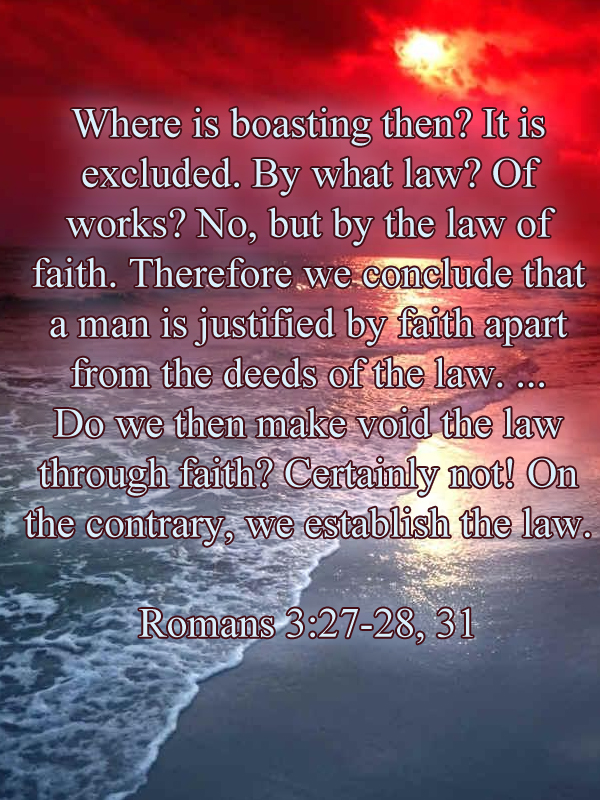
Romans 3:27-28, 31In chapter 3, we read that human beings “are all under sin” (Rom. 3:9). No one is inherently righteousness, not matter how closely they have adhered to the letter of the law. The law lets us know that we have sinned, but does not give justification from that sin.

Now we know that whatever the law says, it says to those who are under the law, that every mouth may be stopped, and all the world may become guilty before God. Therefore by the deeds of the law no flesh will be justified in His sight, for by the law is the knowledge of sin. (Rom. 3:19-20).

It is only through Christ’s sacrifice that we can be cleansed of our sins. Human being cannot earn eternal life by keeping the law because the law was missing a vital aspect. Rather than replacing the law, Jesus Christ’s sacrifice supplied that missing piece.

What purpose then does the law serve? It was added because of transgressions, till the Seed should come to whom the promise was made; and it was appointed through angels by the hand of a mediator. Now a mediator does not mediate for one only, but God is one. Is the law then against the promises of God? Certainly not! For if there had been a law given which could have given life, truly righteousness would have been by the law. But the Scripture has confined all under sin, that the promise by faith in Jesus Christ might be given to those who believe. But before faith came, we were kept under guard by the law, kept for the faith which would afterward be revealed. Therefore the law was our tutor to bring us to Christ, that we might be justified by faith. (Gal. 3:19-24)

Faith does not negate the importance of the law. It adds to the law, giving it new meaning and layers. Because we have been redeemed from sin by Jesus Christ’s sacrifice (1 Cor. 6:19-20), we have an obligation to obey His commandments. These commandments include the updated law, followed in spirit and in truth. Distilled to it’s most basic level, this means we must love God and love our neighbor as ourselves.

Owe no one anything except to love one another, for he who loves another has fulfilled the law. For the commandments, “You shall not commit adultery,” “You shall not murder,” “You shall not steal,” “You shall not bear false witness,” “You shall not covet,” and if there is any other commandment, are all summed up in this saying, namely, “You shall love your neighbor as yourself.” Love does no harm to a neighbor; therefore love is the fulfillment of the law. (Rom. 13:8-10)

Lemon Blueberry Cheesecake Bars

Lemon-Blueberry Cheesecake BarsThe oven is back! As of last Wednesday afternoon, I’ve been able to bake. I promptly made bow-tie pasta, chocolate chip cookies,  easy bread sticks, and now I can finally share these cheesecake bars. The crust came from this recipe, and I borrowed the filling from this Annie’s Eats recipe. The first time I made it and took it to church, I received several compliments on the flavor. In particular, people liked the shortbread crust as an alternative to graham cracker.

Warning: do not attempt to substitute wax paper for parchment paper. It refuses to come out of the pan. Aluminum foil would work much better, I think.

Lemon Blueberry Cheesecake Bars

print this recipe

 Shortbread Crust

1 cup butter

2 cups all-purpose flour

½ cup confectioners’ sugar

Preheat oven to 350°F. Prepared a 9”x13” baking dish with a parchment paper sling. Cut the butter into the flour and confections sugar and press into the baking dish (I use the bread hook attachment on my hand-held electric mixer). Bake 20 minutes or until light brown. Let cool on wire rack.

 Lemon-Blueberry Cheesecake Bars batterFilling

2 (8-oz) packages cream cheese, softened

½ cup sour cream

¾ cup sugar

2 large eggs

1 teaspoon vanilla

pinch of salt

2 Tablespoons fresh lemon juice

1 pint fresh blueberries

Reduce oven temperature to 325°F.

In a large mixing bowl, combine cream cheese and sour cream with an electric mixer. Beat on medium speed until smooth. Add in the sugar and beat on medium-high speed until light and fluffy, about 1-2 minutes. Beat in the eggs one at a time, mixing well after each addition. Blend in vanilla, salt, and lemon juice. Fold in blueberries gently with a spatula until evenly incorporated. Pour mixture over the shortbread crust.

Bake for 35 minutes or until just set and the center no longer jiggles when the pan is tapped. Transfer to a cooling rack and let cool to room temperature. Cover and refrigerate for at least 4 hours before removing from pan using parchment paper. Cut into bars and serve.

print this recipe

cooked Lemon-Blueberry Cheesecake Bars

Writing Heroines

Last week, I wrote a post about the eight hero archetypes listed in The Complete Writer’s Guide to Heroes and Heroines: Sixteen Master ArchetypesI’ve used this book extensively since I discovered it in the library, and I’ve found it a great help in crafting dynamic characters. Characters I wrote before reading it even fit in the archetypes, which I’m taking as a sign that I was on the right track with character development. For these characters, the descriptions have helped me edit them to be stronger and more consistent.

If you’re a writer and you can find a copy of the book, I highly recommend using it. If not, here’s a brief overview of each description for the eight female archetypes. All the quotes below are from the descriptions in the book.

Heroine Archetypes
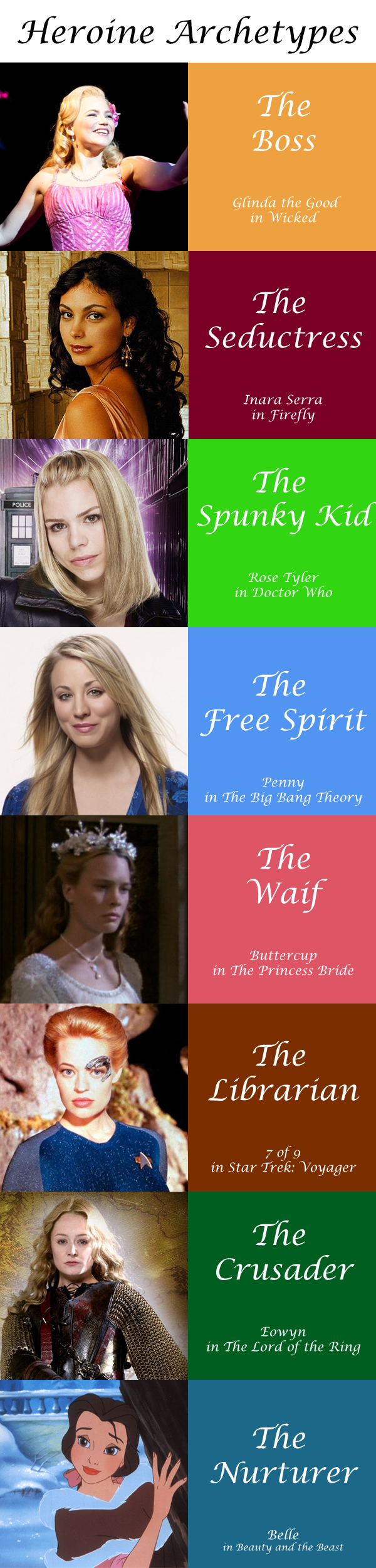
Heroine ArchetypesThe Boss

This is a strong, tough character who wants to win at all costs. Typically, such a character always got her own way growing up and wants that to continue. “She will shade the truth in order to gain her objective and she is not above manipulating circumstances to make things go her way.”

The Seductress

Assertive, strong, and clever, this type of character learned at a young age she could charm people into doing what she wanted. She is cynical, driven, manipulative. “Her true desires and motives are carefully concealed behind a sensual smile. Knowledge is power, so she makes sure no one knows her” and instinctively distrusts people.

The Spunky Kid

This is the “heroine underdog.” She has a sense of humor and is reliable, supportive, unassuming, and skeptical. Sometimes, she “hides behind her sarcastic wit, and her lack of confidence may make her play down her best attributes, but she is spirited, cheerful and the most loyal of friends.”

The Free Spirit

Sincere, upbeat, and imaginative, this type of character can also be impulsive, meddling, and undisciplined. They have a strong sense of individuality and never plan anything, but always seem to land on their feet.  She is a natural entertainer, and “may be a handful for anyone who has to deal with her, but she makes the experience worthwhile in her zany, high-spirited way.”

The Waif

This character is trusting, easily influenced, kind, and insecure. She inspires others to want to save her, and is generally content to let herself be rescued. “Her delicate fragility makes her an easy target … [and] she adapts to any situation she falls into without complaint.” You’re far less likely to see her in fiction of today than the other archetypes, but that does not mean she should be avoided.

There is something refreshing about a heroine who does not talk back or fight every battle, but rather, allows a man to be a man and believes that if left well enough alone, situations will resolve themselves.

The Librarian

This type of character likes to organize everything. She is efficient, serious, dependable, rigid, repressed, and a perfectionist. She assumes she has all the answers and, “more often than not, she is right, but she can be a bit stubborn about considering other opinions.” She is also portrayed as having a passionate side when she “lets her hair down.”

The Crusader

“This is a heroine in the truest sense — deeds of valor are right up her alley.” She is courageous, resolute, and persuasive. Her flaws include obstinacy, rashness, and being outspokenly opinionated. She wants to set the word straight and “has no faith in the intrinsic merit of human nature; no belief that all will end well if left alone.”

The Nurturer

A character of this type needs to be needed. She is optimistic, capable, idealistic, self-sacrificing, and willing to compromise so she won’t hurt anyone’s feelings. Before thinking of herself, “she makes sure that all her loved ones are happy and content … Her serene, capable and patient manner invariably soothes troubled souls or hurting hearts.”

Writing Characters

There are three approaches to using these archetypes to create characters. A character could be a “core archetype,” fitting into a singe archetype and remaining consistent through the course of the story. Characters can also evolve, changing from one archetype to another because of the events of the story. Layered characters have elements of two archetypes, which may take turns being dominant but will not change over the course of the story.

An example of evolving archetypes is the Beast in Beauty and the Beast, who changes from a Lost Soul into a Chief as a result of Belle’s nurturing character. Layered characters include MacGyver (Warrior and Professor), Eliza Doolittle in My Fair Lady (Waif and Spunky Kid), and Princess Leia (Boss and Crusader).

I hope you’ve enjoyed reading about these character types, and that it sparks an idea for your own writing (or at least provided some interesting reading while procrastinating from writing 😉 ).