Seeking God’s Righteousness

I’ve been reading a book called Reclaiming Our Forgotten Heritage by Curty Landry and one of his comments about what we’re supposed to “seek first” caught my eye. This book is about how understanding the Jewish roots of Christianity can transform your faith. It’s amazing to me how much we can miss when we read the Bible in English with a Western cultural mindset. And it’s equally amazing how much it can deepen our understanding of God and His ways to dive-in to the roots of our faith.

One of the things Landry talks about is how our interpretation of words and stories in the Bible can change based on whether we approach them through a Western philosophical lens or a first-century Jewish one. An example is how we see the word “righteousness” in Matthew 6:33.

When we read “seek first the kingdom of God and His righteousness,” we in the Western world tend to think this means we have to be righteous in the sense of being a “law-abiding citizen” of heaven. But a Jewish person listening to Jesus would have thought of the Hebrew concept of tzedakah, which changes how you interpret this verse. Let’s take a look at that.

Righteousness in Hebrew

Tzedakah is about justice, righteousness, and truthfulness (Brown, Driver, Briggs lexicon, entry H6666). It’s associated with God’s fairness and is also tied to acts of charity and giving. At my Messianic congregation, this word is written on the box where we put tithes and offerings because tzedakah is so closely connected with righteous giving.

In her article “God’s Kind of Righteousness,” Lois Tverberg points out that “tzedakah means more than just legal correctness – it refers to covenantal faithfulness, often resulting in rescuing those in distress and showing mercy to sinners.” It’s quite a bit different than what most of us think of when we think “righteousness,” but it’s very much in line with God’s character.

From this Jewish perspective, then, one would better read Matthew 6:33 in this way: “Seek first the kingdom and the righteous acts of God – seek first kindness, seek first abundant benevolence, seek first gracious acts and deliverances – and all these other things will then be added to you.” Read in this way, Matthew 6:33 requires a daily walk of faith that still challenges me to this day. (Landry, p. 134).

Seeking God's Righteousness | LikeAnAnchor.com
Photo credit: Pearl via Lightstock

Doing and Believing

It might not sit well with many American Christians that we need to do what is right in addition to believing what is right. Or, depending on exactly what you believe, it might be challenging to know that our obedience has to go beyond legal correctness. But as a deeper look into tzedakah demonstrates, true faith involves ongoing growth and change as we become more and more like God. Nothing we can do will save us — “by grace you have been saved through faith, and that not of yourselves; it is the gift of God” (Eph. 2:8, all scriptures from the WEB translation). But after we’re saved, we do take certain actions in accordance with God’s ways — “faith, if it has no works, is dead in itself” (James 2:17).

He has shown you, O man, what is good. What does Yahweh require of you, but to act justly, to love mercy, and to walk humbly with your God? (Micah 6:8)

Jesus called justice, mercy, and faith “the weightier matters of the law” (Matt. 23:23). These are things which must not be left undone by God’s people. And though righteousness isn’t on this list, it is closely associated with mercy and justice (see Ps. 33;5; 889:14; Is. 16:5; Hos. 2:19). We’re supposed to become like God and since righteousness is part of His character it should be part of ours as well.
Yahweh, Our Righteousness

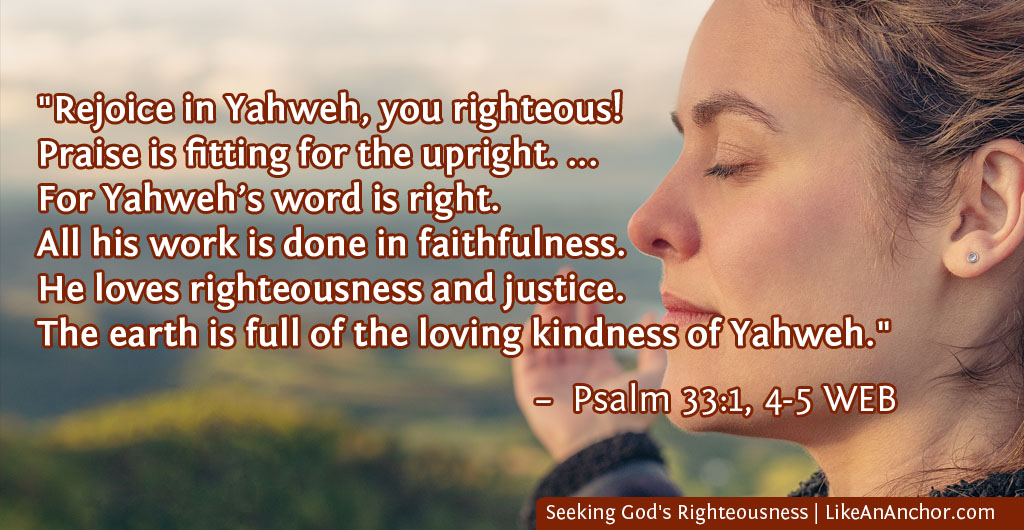
Our God loves righteousness (Ps. 11:7; 33:5). He even reveals it as one of His names which He puts on His people — Yahweh Tsidqenu, the Lord our Righteousness (Jer. 23:6; 33:16). In the Matthew 6:33 verse we opened with, Jesus doesn’t say “seek to be righteous” or that we should seek righteousness in general. He’s very specific. We are to seek God’s righteousness.

Yahweh says, “Don’t let the wise man glory in his wisdom. Don’t let the mighty man glory in his might. Don’t let the rich man glory in his riches. But let him who glories glory in this, that he has understanding, and knows me, that I am Yahweh who exercises loving kindness, justice, and righteousness in the earth, for I delight in these things,” says Yahweh. (Jer. 9:23-24)

Knowing God involves understanding that He exercises and loves righteousness. If we want to be righteous as He is, we need to come to Him. He will reveal His righteousness when we follow His ways and keep seeking Him, as Jesus told us to in Matthew 6:33 (Is. 54:17; 56:1; 61:10).

Pursue His Righteousness

Seeking God's Righteousness | LikeAnAnchor.com
Photo credit: Anggie via Lightstock

Returning to the idea that righteousness involves more than just law-based obedience, Jesus taught “that unless your righteousness exceeds that of the scribes and Pharisees, there is no way you will enter into the Kingdom of Heaven” (Matt. 5:20). He said this during the same sermon where He told us, “seek first God’s Kingdom and his righteousness.” Seeking righteousness is a foundational part of our faith, and yet the most scrupulously obedient religious elite of Jesus’ day didn’t practice God’s righteousness in a way that pleased Him. There is more to it than simply following rules.

We aren’t saved based on how well we measure up to God’s just laws. Jesus Christ died for us “so grace might reign through righteousness to eternal life” (Rom. 5:21). As we talked about earlier, God’s type of righteousness has to do with His kindness and benevolence — righteous acts that spring from His righteous character. His righteousness toward us isn’t about legal justification based on us already being perfect, but rather about bringing us into a right state with Him and empowering us to follow His example of righteous doing (Rom. 3:21-31).

Through Christ, we have “become the righteousness of God” (2 Cor. 5:21). We’re to be “filled with the fruits of righteousness, which are through Jesus Christ, to the glory and praise of God” (Phil. 1:11). Righteousness isn’t just passively applied, though. We must “follow after righteousness” (1 Tim. 6:11; 2 Tim. 2:22) and seek God’s “instruction in righteousness” from scripture (2 Tim. 3:16; Heb. 5:13). To quote Curt Landry again, seeking first God’s kingdom and His righteousness “requires a daily walk of faith” that challenges each of us today.

Featured image credit: Pearl via Lightstock

5 Things Introverts Do That Might Seem Normal to Them, but Are Actually Rude or Annoying

The introvert possibility movement has been a wonderful thing for quiet people. Finally, we introverts are being seen as people with their own unique gifts and talents rather than a “broken” extroverts.

It has also had some unintended negative effects, though. One of these is that some (though of course not all) introverts use their introverted nature to excuse behaviors that most people actually consider rude or annoying. I’ve done it myself from time to time. But it’s not a good things and I really think we should stop.

I hesitated to write this post because so many introverts have been wrongly accused of being rude simply because people misinterpret our introverted natures. We talked about that in a post earlier this week, “5 Things Introverts Do That Might Seem Rude to Others, but Are Actually Normal For Us.” But setting that aside, there are certain things that some introverts do that really can be rude or annoying and which we use our introverted nature as an excuse for. Let’s take a look at five of them.

1) Refusing To Small Talk

I know, I know — introverts hate small talk because it creates barriers between people. Well guess what? Most people hate spending all their time on small talk. But they also recognize that small talk is an important step in relationships and there are times when refusing to engage in small talk is just plain rude. Read more

5 Things Introverts Do That Might Seem Rude to Others, but Are Actually Normal For Us

Many introverts, including me, have been accused at various time of being rude, annoying, or arrogant. While it’s true that an introvert could be all those things, in many cases the issue is a misunderstanding rather than intentional rudeness on the introvert’s part.

No one should get a pass on being rude, including introverts. But sometimes things that may come across as rude to others are just an accidental “side effect” of how the introvert prefers to interact with the world. Instead of being caused by something the introvert is doing wrong, the idea that we’re rude is based on false assumptions other people make about our motives.

This sort of misinterpretation can come from fellow introverts as well as from extroverts. I’ve heard several people who I know are introverted make comments about how someone who’s quiet (and who I know is uncomfortable in groups) seems stand-offish or stuck-up. Even when we ourselves know what it’s like to be a quiet person we can still misinterpret quietness in others.

1) Watching Instead of Interacting

This is one of the most common things introverts do and it’s also one of the things that’s most often interpreted as being rude. Usually what happens is the introvert is in some kind of group where there’s more than one other person around, and the introvert is watching what’s happening instead of engaging in conversation or participating in an activity.

People assume this is rude when they start pretending they can read minds. They may think the introvert is bored with what’s going on and wants to leave. Some might assume the introvert is silently judging everyone else and feels like they’re “too good” for the people around them. Other could say the introvert must hate people because they’re not having fun.

In the introvert’s head, though, it’s far more likely that they’re enjoying the gathering in their own way. We like listening and observing. We’re comfortable with silence. We’re probably having more fun on the sidelines than we would be as the center of attention. Of course, there’s always a chance that we might be distracted by our own thoughts or trying to think of a polite way to leave because our social batteries have run low but even then most of us don’t mean to be rude.

2) Avoiding Other People

This one can be rude or not rude depending on the context. Actively avoiding someone for no good reason, refusing to answer a friend’s message, or otherwise vanishing from people’s lives is (usually) rude. But it’s not rude to eat lunch alone because you need a break from people during your workday. It’s not rude to decline an invitation to a weekend party because you’ve been doing something social most of the week and need a break.

We need to learn to balance our “introvert time” and our investments in relationships. But the people around us also need to learn that introverts need their down time in order to function. Let introverts recharge and we’ll be much more likely not to avoid all human interaction.

3) Keeping Your Personal Life Private

This should be a no-brainer. After all, someone’s personal life is by definition personal. But sometimes people think it’s rude if someone decides not to share personal information. This is, quite frankly, a “them problem.” Neither introverts nor extroverts are obligated to share things they want to keep private with other people. It’s not rude if you choose not to share personal stories.

Introverts tend to be fairly private people and may keep things to themselves that others are comfortable letting everyone know. If an introvert chooses not to share something with you, don’t take it as a sign that they don’t trust or like you. They might simply be choosing to keep their personal lives private and that’s okay.

4) Being Nervous in Social Situations

Introverts tend to have a limited amount of social energy. While we all have an extroverted side, how strong it is varies depending on the individual introvert. Every introvert can reach a point where socialization is too overwhelming and they’re ready to go home and recharge. Plus, on top of the fact that social situations are draining, many introverts also struggle with nervousness when meeting new people. And some of us have social anxiety and/or shyness that we’re dealing with, too.

A nervous introvert can come across to others as standoffish. The introvert might be panicking about what to say next while the other person thinks its rude that they’re being so quiet. Though some may assume the introvert thinks they’re better than everyone else, it’s much more likely that a socially nervous introvert is just really worried about making a good impression or is wondering why someone wanted to talk with them.

5) Respecting Other’s Need For Space

5 Things Introverts Do That Might Seem Rude to Others, but Are Actually Normal For Us | LikeAnAnchor.com
Photo credit: lisa runnels via Pixabay

This point sounds like something that no one could misinterpret as rude, but hear me out. What looks to an introvert like simply being polite can look like indifference to someone else. This point is illustrated perfectly in an Introvert Doodles comic comparing what being polite looks like for introverts vs. extroverts.

For example, if an introvert declines an invitation to stick around after they’ve unexpectedly run across someone, they probably mean to be polite by not inconveniencing them. An extrovert in a similar situation might think turning down that invitation is rude or insulting because it sends the message you don’t want to be around the other person. Same situation, different perspectives on what’s polite. Neither perspective is necessarily wrong but if we don’t recognize that there are different perspectives it can lead to misunderstandings.


What are some things you do as an introvert that people have incorrectly interpreted as you trying to be rude?


Featured image credit: Jose Antonio Alba via Pixabay

What Laodicea Doesn’t Know Can Hurt Us

In Revelation, the church in Laodicea received a warning and correction from Jesus that had to do with how they saw themselves.

To the angel of the assembly in Laodicea write: “The Amen, the Faithful and True Witness, the Beginning of God’s creation, says these things: ‘I know your works, that you are neither cold nor hot. I wish you were cold or hot. So, because you are lukewarm, and neither hot nor cold, I will vomit you out of my mouth. Because you say, ‘I am rich, and have gotten riches, and have need of nothing;’ and don’t know that you are the wretched one, miserable, poor, blind, and naked.'” (Rev. 3:14-17, all scripture references from WEB translation)

The things that the Laodiceans didn’t know about themselves were a threat to their spiritual position in Christ. He threatens to vomit them out of Him if they are not zealous to repent (Rev. 3:19). That’s pretty serious, and we can learn from His advice to them how to avoid similar mistakes.

Those who see the letters in Revelation as pictures of eras in the church tend to agree that we are currently living in the Laodicean era. And even if that’s not the case, those who “have an ear” are still instructed to “hear what the Spirit says to the churches” (Rev. 3:22). If we, like the Laodiceans, are ignorant of about our true spiritual condition then we need to heed this warning to wake up to the truth and change how we’re living.

Wretched and Miserable

Jesus starts out by telling the people who think they’re okay that they are in fact “wretched and miserable.” It reminds me of what Paul said in one of his letters: “let him who thinks he stands be careful that he doesn’t fall” (1 Cor. 10:12). Each of the words translated “wretched” and “miserable” are only used one other place in the Greek New Testament.

What a wretched man I am! Who will deliver me out of the body of this death? I thank God through Jesus Christ, our Lord! So then with the mind, I myself serve God’s law, but with the flesh, sin’s law. There is therefore now no condemnation to those who are in Christ Jesus, who don’t walk according to the flesh, but according to the Spirit. (Rom. 7:24-8:1)

Paul’s mindset was completely different than the Laodiceans. He knew he was in a wretched state and the only solution was to turn to Jesus for deliverance. This is reflected in his use of the word for miserable/pitiable as well. Read more

Everyone Has Layers, Including Introverts and Extroverts

I recently read an article that made the claim extroverts will never understand that an introverted personality has multiple layers. I’m not going to link to this article because it’s not my intention to attack the writer, but I mention it to highlight a common misconception among introverts — that our personalities are more complex than extroverts.

The truth is, all people have layers. And we all — both introverts and extroverts — have a tendency to assume that how we see people act initially is how they act all the time. We meet someone who seems chatty and friendly, we assume they’re generally a talkative and friendly person. We meet someone who’s quiet and reserved, we assume they’re generally a private, quiet person.

But just as introverts don’t want people to assume they’re nothing more than a quiet person who doesn’t speak up much in crowds, extroverts don’t want people to assume there’s nothing more to them than the life-of-the-party social butterfly. We’re all complex, layered people with nuances to our personalities.

The Masks We Wear

Introverts often talk about how we wear different “masks” in different situations. We have our social mask that we put on when hanging out with a group or meeting new people. In this mask, we can be so engaging and talkative that sometimes people might even mistake us for extroverts. And we might have other masks, too — the professional one we put on for work, the polite one we wear interacting with retail workers, the “don’t talk to me” one we wear when in a public place and we don’t want disturbed.

We don’t usually think of the version of ourselves we show the world (especially new acquaintances) as a complete picture of who we really are. Introverts tend to be private people who keep a large part of their personalities hidden. We take time to open up to people and let them see behind any of our masks.

The thing is, extroverts do this too. Even the most social extrovert has layers to their personality that they don’t share with everyone. Extroverts also wear masks to fit in with different social situations and groups, just like introverts do. Depending on their personality type and individual preferences, some extroverts might be even more private than introverts regarding their personal lives.

Read more

How Do I Know If I’m an INTJ or an INTP?

After learning about Myers-Briggs® types and taking a few tests, one question you might have is how to tell which of two similar types you are. Taking multiple online tests often gives you several different results, so that’s one way this question can come up. Or maybe you started reading about the types and realized more than one sounds like you.

If you’re trying to decide whether you’re more of an INTJ or an INTP type, I hope this article helps. Just looking at the letters in these two types, we might think the only difference between them is that one’s a perceiving type and one is a judging type. This is only party true. When we dive deeper into the cognitive functions each Myers-Briggs® type uses, it become easier to see the differences and similarities between these two types’ mental processes more clearly.

If you’re not familiar with cognitive functions, click here to read “The Simplest Guide to Myers-Briggs® Functions Ever.” INTJs and INTPs might look similar at first, but they use completely different functions, as shown in this graphic:How Do I Know If I'm an INTJ or an INTP? | LikeAnAnchor.com

The way these cognitive functions work together makes INTPs and INTJs similar in some ways and very different in others. They might seem near-identical times but their underlying thought patters and motivations don’t look nearly as much alike as you might think. Read more