Chocolate Chip Oatmeal Walnut Bars

Chocolate Chip Oatmeal Walnut Bars recipe by marissabaker.wordpress.com

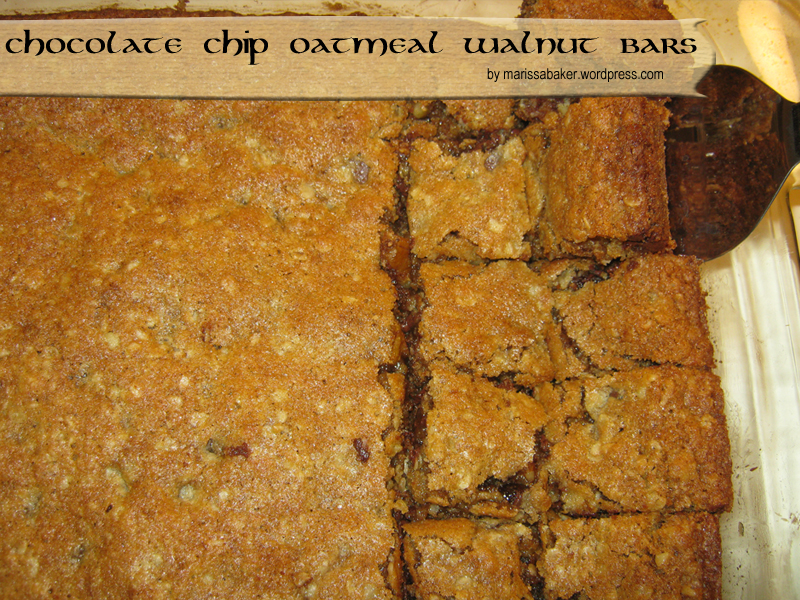
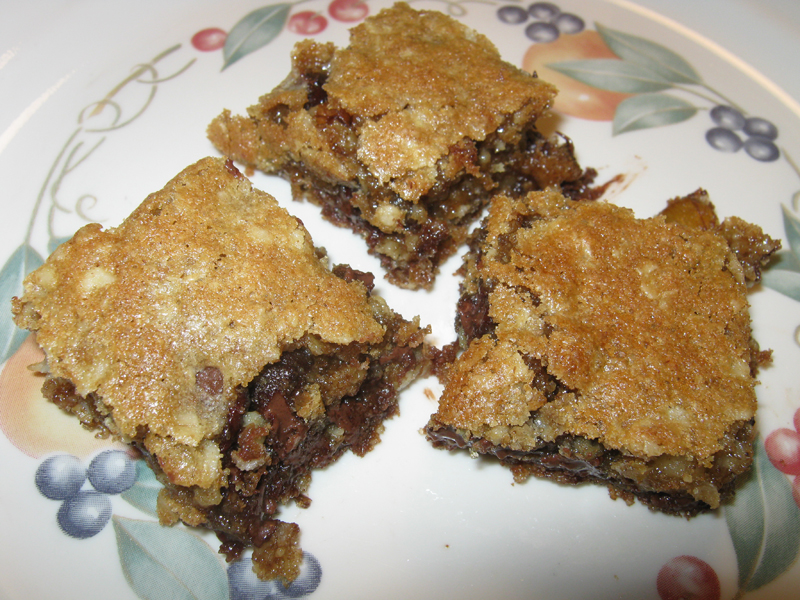
There are few foods I like better than warm oatmeal walnut bars fresh from the oven, oozing chocolate when you cut into them. The only problem is that they are so tasty — and just as addictive as my blond brownies — that is is hard to save enough to take to whatever event I decided to bake them for.

Chocolate Chip Oatmeal Walnut Bars

Chocolate Chip Oatmeal Walnut Bars recipe by marissabaker.wordpress.comprint this recipe

1 cup butter, softened

3/4 cup packed brown sugar

1/2 cup sugar

2 teaspoons vanilla extract

2 eggs

1 1/4 cups old-fashioned rolled oats

Chocolate Chip Oatmeal Walnut Bars recipe by marissabaker.wordpress.com1 cup whole wheat flour

1/4 cup all-purpose flour

1 teaspoon baking soda

Dash salt

1 (12-oz.) pkg. chocolate chips

1 cup chopped walnuts

Beat butter, brown sugar, sugar and vanilla in a large bowl until smooth. Add eggs one at a time, mixing well after each addition.Chocolate Chip Oatmeal Walnut Bars recipe by marissabaker.wordpress.com

Combine oats, whole wheat flour, all-purpose flour, baking soda and salt in medium bowl. Slowly add flour mixture to butter mixture, beating until well-blended. Stir in chocolate chips and walnuts.

Spoon and spread dough in greased 15x10x1-inch pan. Bake at 375°F for 15 to 20 minutes or until golden brown. Remove to counter and let cool.

print this recipe

Chocolate Chip Oatmeal Walnut Bars recipe by marissabaker.wordpress.com

Empathic Feeling

I realized Tuesday night when I was reading Fire by Kristin Cashore and crying into the bath water that I wasn’t crying because I felt sad a character had died. I was crying because someone in the book felt sad that this character had died. Once I thought about it, I realized that at least half of the times when fiction moves me to tears, it is in empathy with the characters rather than my own feelings being affected. In other words, I’m crying because the character is crying, not because of what moved the character to tears. Sometimes it is both (Ender’s Game, for example).

This feeling other people’s feelings (fictional and real) is something I didn’t have much of a grasp on until I discovered my Myers-Briggs type and started reading what other INFJs wrote about being overwhelmed with the emotions of others. Adding high sensitivity to the mix only heightens this (here is a wonderful article about Elaine Aaron’s research on the Highly Sensitive Person).

A Range of Empathy

The extent to which INFJs report feeling other people’s emotions range from an awareness of how others are reacting, to not being able to remember the last time you experienced a feeling that belonged only to you. “You feel it, I feel it,” an anonymous INFJ wrote. I may not be quite ready to claim my feeling of and for others reaches that extent, but I share her decision to try and avoid encountering strong negative emotions (e.g. a news story about child molestation, a film where a family is torn apart, real-life conflict) because of how overwhelming it is — emotionally as well as physically in terms of headaches and stomach pain.

Managing Feelings

In INFJ Coach’s series of blog posts on “10 Steps to an Amazing INFJ Life,” part two is “Manage Those Pesky Emotions.” Her article is mainly about dealing with our own emotions when they surface, but the comments point out that this is only part of the problem. One commenter named Jennie wrote that she asks herself,

“Is this my emotion that I’m feeling, or is it someone else’s emotion?’ Many of us INFJs are emotional sponges for the emotions that other people are feeling. Our NF gives us a very high degree of empathy, but sometimes taking on other people’s emotions can be too much to handle.

The other side to this is what INFJ writer Cheryl Florus points out in Personality Junkie’s INFJ Strategies for Dealing with Emotions: Part I. Because an INFJ’s feeling is extroverted, we often have an easier time understanding the emotions of other people than our own emotions (for more on function stacks, see this post). We feel emotions strongly, but need to make an effort to learn how to experience and express them in a way that doesn’t seem overwhelming or uncontrolled. Often, writing down or talking about our emotions is a way to get them outside us so we can look at them more objectively (I keep a journal and talk to my closest family members). Sometimes, until I’ve done this, I’m not exactly sure what it is I’m feeling, let alone how it should be expressed and dealt with.

What about you? Are you an INFJ with experience feeling other people’s feelings (or a non-INFJ who does the same thing, because I’d love to hear from you)? Or are you someone who has never had this happen and thinks we’re crazy?

Five Favorite Proverbs

Five Favorite Proverbs by marissabaker.wordpress.comFor our ladies’ book club next month at church, while people are getting caught-up on finding and reading the next book, we are studying Proverbs. This was inspired by the author of our last book, Liz Curtis Higgs, who is working through a 50 Favorite Proverbs Bible study on her blog. We’re each planning to bring a single Proverb to the group and talk about it. I’ve been preparing for this by reading Proverbs, and I’ve already found many more favorite proverbs than just one. Since I can’t take them all to our book club, I’ve decided to blog about them. I’ve selected five from the first ten chapters of Proverbs to share here.

In other news, my father has started a blog called Baptism For Life. If you like my Christian posts every Saturday, you’ll probably like his writings.

1: Repentance

Turn at my rebuke; surely I will pour out my spirit on you; I will make my words known to you. (Prov. 1:23)

This is wisdom personified and speaking, but I think from the way it is written (and the fact that, as scripture, it is inspired by Him) we can attribute these words to God. It is a promise, and a call to repentance. If we turn when we hear His reproof, instead of ignoring Him, He will pour out His spirit on us and teach us by revelation.

2: Security

But whoever listens to me will dwell safely, and will be secure, without fear of evil.” (Prov. 1:33)

This is a comforting reassurance of God’s protection for those who serve him — both to give them safety and to guard them from anxiety. Psalm 112:7 says, “He will not be afraid of evil tidings; his heart is steadfast, trusting in the Lord.” It is not necessarily that we will be protected from every bad thing, but a promise that God will be there for us through every thing. His peace “will guard your hearts and minds through Christ Jesus” (Phil. 4:7).

3: Fearless

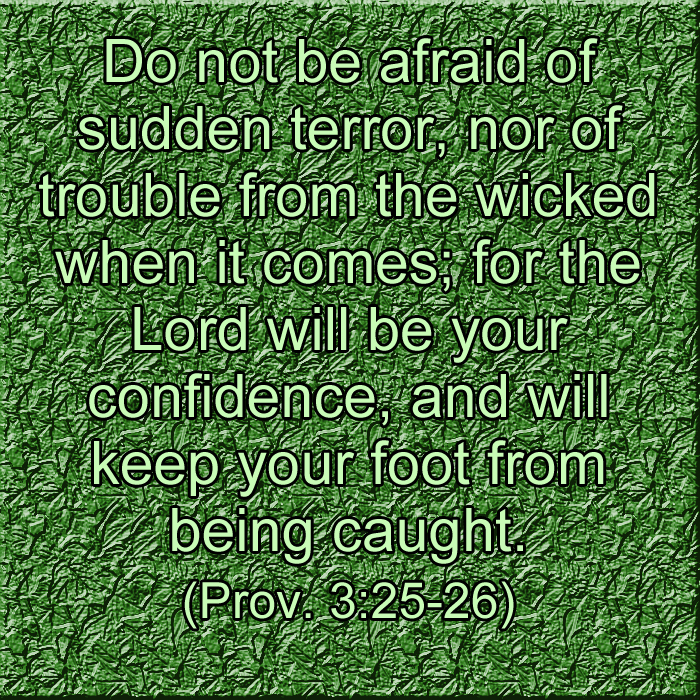
Do not be afraid of sudden terror, nor of trouble from the wicked when it comes; for the Lord will be your confidence, and will keep your foot from being caught. (Prov. 3:25-26)

I’ve always been partial to, and comforted by, the “do not fear verses.” I struggle with fear and anxiety, but it comforts me beyond measure to know that I can turn that fear over to my Protector, who is the most powerful Being in existence. His is our confidence, and no one is able to take us out of His hands (John 10:28-29).

4: Relationship

My son, keep your father’s command, and do not forsake the law of your mother. Bind them continually upon your heart; tie them around your neck. When you roam, they will lead you; when you sleep, they will keep you; and when you awake, they will speak with you. (Prov. 6:20-22)

I love this scripture necklace, and I plan to get one as soon as I can decide what verse I want (anything up to 50 characters). The artist is an Etsy seller.

As Liz Curtix Higgs said when writing about Proverbs 3:3 (which I would list as a favorite, but she covered it thoroughly in her post), we need to keep God’s words close to us. We need to read and study the Bible, continually binding it to our hearts, fall asleep with God’s words in our minds, and wake to let Him talk to us again. We might, as she also suggested, quite literally wear them around our necks.

5: Love

Hatred stirs up strife, but love covers all sins. (Prov. 10:12)

When I read this verse, I wondered why it wasn’t the first thing that came to mind when I thought of favorite Proverbs. The conditions of our heart spill out into our lives, either to stir up strife or to promote peace. When Peter quotes this proverb, he says “above all things have fervent love for one another, for ‘love will cover a multitude of sins'” (1 Pet. 4:8). This, along with 1 Corinthians 13, express how very important love is — “above all things.” We must be on guard that our lives are expressions of love that covers sin and promotes peace, rather than expressions of hatred that leads to discord.

What are some of your favorite Proverbs? Why do those verses speak to you?

Chicken Divan

Chicken Divan recipe by marissabaker.wordpress.comI wish I could tell you the name of the recipe book I found this in, but it’s old and the front and back covers have long since been lost. Regardless, it is an easy dish that has become a popular choice in our house. Evey time I say I’m not sure what to make for lunch, my brother tells me to bake chicken divan. There’s rarely left overs here, but it does heat up well the next day.

In other news, there’s a Scarlet Pimpernel Quotation Challenge and Giveaway running now until Feb. 14 on Musings of an Introvert for the Anthony Andrew’s blog hop. If you’re interested, make your way over there and see how many quotations you can complete.

Chicken Divan

Chicken Divan recipe by marissabaker.wordpress.com
If using brown rice, start it cooking about the same time as the chicken

print this recipe

1 teaspoon olive oil

4 cups chicken, cut into small pieces

4 cups chopped carrots, cauliflower, and broccoli

1 teaspoon curry powder

1 can cream of chicken soup

½ cup mayonnaise

1 cup shredded cheddar cheese

Heat olive oil in skillet over medium heat. Cook chicken until done.

Chicken Divan recipe by marissabaker.wordpress.com
Spread sauce evenly over the chicken and vegetables

Meanwhile, place vegetables with water in a medium saucepan and bring to a boil. Let cook for a couple minutes. Drain vegetables.

Place vegetables on the bottom of a 9×13-in. baking pan . Top with cooked chicken. Mix cream of chicken soup, curry powder, and mayonnaise. Spread over chicken mixture. Top with cheddar cheese.

Cover with aluminum foil and bake 20 minutes at 350°F. Remove foil and book another 5 to 10 minutes, or until cheese is melted and starting brown and sauce is bubbling around the edges. Serve with rice.

print this recipe

Chicken Divan recipe by marissabaker.wordpress.com
Fresh from the oven

Sir Percival Blakeney. Baronet.

A blog I follow is participating in the Anthony Andrew’s Blog Hop this month, and after reading her post I decided to give it a go. The Scarlet Pimpernel (1982) has long been one of my favorite films, ever since my mother shared it with my sister and I as children. As a reader, of course the next thing I did was look up the books, which are just as enjoyable as the film.

Sir Percy’s Background

The 1982 film is based on two books by Baroness Emmuska Orczy: The Scarlet Pimpernel and Eldorado. According the extremely reliable site that is Wikipedia, Orczy may or may not have been the first to write a “hero with a secret identity.” It is quite likely that she influenced, if not inspired, the creation of later nobleman-hero characters like Zorro and Batman. She released 16 books related to the Scarlet Pimpernel, including novels and two short story collections directly related to Sir Percy’s exploits as well as a few novels about his relatives.

“We seek him here, we seek him there. Those Frenchies seek him everywhere! Is he in heaven? Or is he in hell? That demmed Elusive Pimpernel?”

The first book was published in 1905. It is set in 1792 in the midst of the French Revolution. Sir Percival Blakeney is one of the wealthiest and laziest men in England (he does, in fact, bear more than a passing resemblance to Johnston McCulley’s Don Diego Vega [aka Zorro], who debuted in 1919). The most ambitious thing he does is write poetry (see photo caption for a sample). At least, that’s what he wants people to think.

Behind this carefully cultivated facade, Sir Percival Blakeney is The Scarlet Pimpernel, a daring Englishman who leads a band of adventurers into France to rescue people from Madam la Guillotine’s blade. He usually meets with success, which earns him a dedicated adversary named Chauvelin (played by Ian McKellen).

Anthony Andrew’s Percy

Sine 1917, there have been several film and television adaptations of The Scarlet Pimpernel. I’ve not watched them all, or even most of them, but I doubt any of the actors could rival Anthony Andrew’s portrayal of Sir Percival Blakeney. He is the Scarlet Pimpernel — even when I read the books I can hear his voice in my head every time Percy has written dialogue. I hardly ever refer to the character without saying “Sir Percival Blakeney. Baronet” with the same affected pause that Anthony Andrew’s Sir Percy speaks with when introducing himself.

For my readers who are Myers-Briggs fans, one of the other writers participating in this blog hop typed Sir Percy as an ENFP. It makes sense — he is a visionary, a crusader, an idealistic champion who lives to right wrongs. The traits that are common to Champion/ENFP types serve him well as a hero with a secret identity. David Keirsey says people of this type

have outstanding intuitive powers and can tell what is going on inside of others, reading hidden emotions and giving special significance to words or actions. In fact, Champions are constantly scanning the social environment, and no intriguing character or silent motive is likely to escape their attention. Far more than the other Idealists, Champions are keen and probing observers of the people around them, and are capable of intense concentration on another individual. Their attention is rarely passive or casual. On the contrary, Champions tend to be extra sensitive and alert, always ready for emergencies, always on the lookout for what’s possible.

Sounds like the Scarlet Pimpernel to me, and Anthony Andrew’s portrays him perfectly. I’ve seen analysis written about certain actors’ eyebrows (yes, I have too much time on my hands for looking up weird things on the Internet), and we could certainly add the way Anthony Andrew’s raises his eyebrow when Percy is scanning a room to the list of analysis-worthy eyebrow-acting. You can tell in an instant, just by his posture and the look in his eyes, when he shifts from lazy Sir Percy to alert Scarlet Pimpernel.

Bog Hopping

I hope you’ll check out some of the other blogs in this blog hop. Anthony Andrews is not an incredibly prolific actor, but he is in several good films which are being covered by other bloggers this month. I’m looking forward to reading more of them myself. Since I’m on WordPress (which doesn’t support Javascript), you’ll have to click the link below to see other posts in the blog hop:

Powered by Linky Tools

Click here to enter your link and view this Linky Tools list…

Forgetting God

I was reading Hosea early this week when two phrases jumped out at me from this verse:

My people are destroyed for lack of knowledge. Because you have rejected knowledge, I also will reject you from being priest for Me; because you have forgotten the law of your God, I also will forget your children. (Hos. 4:6)

The phrases were “rejected knowledge” and “thou hast forgotten the law of God.” I also accidentally loaded an NIV translation which renders the word “forgotten” as “ignored.” I’m not sure which translation I like better — forgetting makes me think of gradually letting something slip your mind because you don’t think about it, while ignoring sounds more like a conscious choice. Either way, it is a dangerous thing to do with God’s law.

Hear the word of the Lord, you children of Israel, for the Lord brings a charge against the inhabitants of the land: “There is no truth or mercy or knowledge of God in the land.” (Hos. 4:1)

Destruction comes upon those who reject knowledge of God, and who forget God’s law. It is so very important that we continue to grow in knowledge of God and keep His commandments.

Knowledge of God

According to my study Bible, the Hebrew word translated “knowledge” is H1847 dha’ath. it refers to knowledge gained through the senses, and is the opposite of “folly.” Meanings include knowledge, insight, intelligence, understanding, and wisdom. “Knowledge of God,” Zodhiates writes, “describes the proper relationship between God and a man who truly obeys Him.”

"Forgetting God" by marissabaker.wordpress.comAnd this is eternal life, that they may know You, the only true God, and Jesus Christ whom You have sent. (John 17:3)

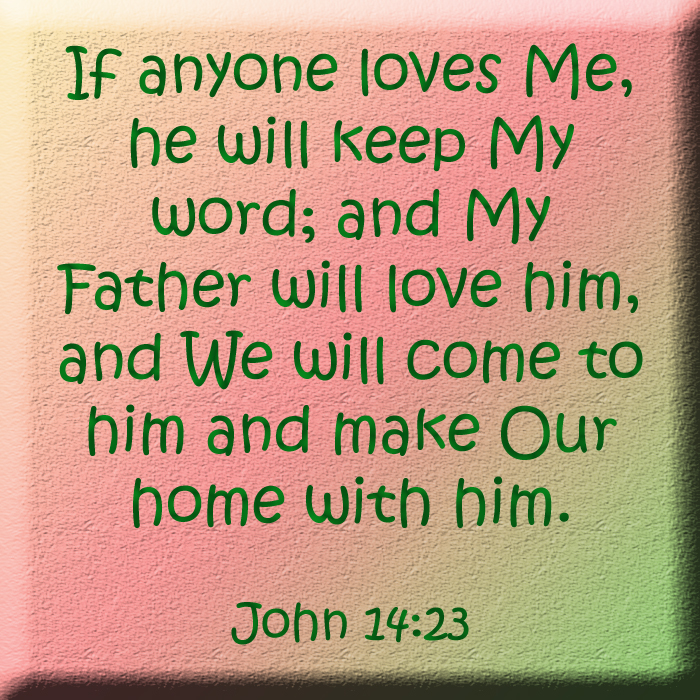
Jesus answered and said to him, “If anyone loves Me, he will keep My word; and My Father will love him, and We will come to him and make Our home with him. (John 14:23)

Knowledge of God increases as we grow into a closer relationship with Him. They are inseparably connected. If we reject knowledge of God, we reject a relationship with Him. As pointed out in the definition of dha’ath, a relationship with Him is dependent on keeping His laws. God cannot be in fellowship with a person who is walking contrary to Him.

And after all this, if you do not obey Me, but walk contrary to Me,then I also will walk contrary to you in fury; and I, even I, will chastise you seven times for your sins. (Lev. 26:27-28)

Do Not Forget

Take heed to yourselves, lest you forget the covenant of the Lord your God which He made with you, and make for yourselves a carved image in the form of anything which the Lord your God has forbidden you. (Deut. 4:23)

The Israelites were commanded, multiple times, to remember all God had done for them, and to teach their children His laws “That they may set their hope in God, and not forget the works of God, but keep His commandments” (Ps. 78:7). But “they forgot God their Savior,” and did not teach His laws to their children (Ps. 106:21). This set up generational cycles of forsaking God, punishment, repentance and forgiveness, and then forgetting God again.

Can a virgin forget her ornaments, or a bride her attire? Yet My people have forgotten Me days without number. (Jer. 2:32)

"Forgetting God" by marissabaker.wordpress.comCan you feel God’s heartbreak in this verse? His presence is what made His people beautiful and His grace clothed them in dignity, yet they cast Him away (Ezk. 16:8-14). It’s as unthinkable as a bride forgetting to put on her wedding dress before walking down the aisle, but it happened over and over again.

In Psalm 50, God addresses the wicked who “hate instruction” and  “cast My words behind you,” asking them “What right have you to declare My statutes, or take My covenant in your mouth?” (Ps. 50:16, 17). These people were thieves, adulterers, liars, slanderers, and evil supporters of others who committed sin (Ps. 50:18-20). Though they knew God’s law, they thought He would overlook their sins — an error He corrects.

These things you have done, and I kept silent; you thought that I was altogether like you; but I will rebuke you, and set them in order before your eyes. “Now consider this, you who forget God, lest I tear you in pieces, and there be none to deliver: whoever offers praise glorifies Me; and to him who orders his conduct aright I will show the salvation of God.” (Ps. 50:21-23)

As this last verse hints, there is an antidote to forgetting God. On the night of His betrayal, Jesus promised His disciples that He would send them the Holy Spirit, which would “teach you all things, and bring to your remembrance all things that I said to you” (John 14:26). Keeping God’s commandments puts us into a right relationship with Him, and gives us access to aid through the Holy Spirit.

The Law of God

To recap (since this has become a long post), God says in Hosea 4:6, “because you have forgotten the law of your God, I also will forget your children.” Keeping God’s law close to our hearts and minds, holding it in remembrance, is key to knowing Him and maintaining a lasting relationship.

The law of the Lord is perfect, converting the soul; the testimony of the Lord is sure, making wise the simple; the statutes of the Lord are right, rejoicing the heart; the commandment of the Lord is pure, enlightening the eyes; the fear of the Lord is clean, enduring forever; the judgments of the Lord are true and righteous altogether. More to be desired are they than gold, yea, than much fine gold; sweeter also than honey and the honeycomb. Moreover by them Your servant is warned, and in keeping them there is great reward. (Ps. 19:7-11)
"Forgetting God" by marissabaker.wordpress.comThis is why it makes no sense to say Jesus Christ did away with the law under the New Covenant. Keeping the commandments is how we show God and Jesus that we love Them (John 14:15, 21, 23; 15:10, 14). We can’t pick-and-choose which parts of the commandments we want to obey, either: “All Scripture is given by inspiration of God, and is profitable for doctrine, for reproof, for correction, for instruction in righteousness, that the man of God may be complete, thoroughly equipped for every good work” (2 Tim. 3:16-17).

“Do not think that I came to destroy the Law or the Prophets. I did not come to destroy but to fulfill. For assuredly, I say to you, till heaven and earth pass away, one jot or one tittle will by no means pass from the law till all is fulfilled. Whoever therefore breaks one of the least of these commandments, and teaches men so, shall be called least in the kingdom of heaven; but whoever does and teaches them, he shall be called great in the kingdom of heaven.” (Matt. 5:17-19)

Jesus warns that breaking “the least of these commandments” will make us “least in the kingdom of heaven.” Other scriptures reveal that a pattern of sin will block us from the kingdom all together (Gal. 5:19-21). Forgetting and rejecting God by turning our backs on keeping His laws is like asking Him to forget about and reject us. But, thankfully for us, the flip-side of this is that showing our love for God by obeying Him puts us into a personal relationship with Him that has incredible, lasting rewards.

He who has My commandments and keeps them, it is he who loves Me. And he who loves Me will be loved by My Father, and I will love him and manifest Myself to him. … If anyone loves Me, he will keep My word; and My Father will love him, and We will come to him and make Our home with him. (John 14:21, 23)