Sweet Potato Casserole

Sweet Potato Casserole recipe marissabaker.wordpress.com
our sweet potato harvest

We grew sweet potatoes in the garden for the first time this year. I wasn’t quite prepared for how deep and far away from the base of the plant they grow — we cut several in half with the spade and potato fork. My brother started excavating them with his hands, and he proved to be the most successful at locating sweet potatoes. Per instructions we found online, we let the potatoes sit for about a week before using them.

This casserole was the result of experiments combining several recipes last year. It cooked up splendidly with these new sweet potatoes, and I decided to post this finished version. If you use enough sweet potatoes, it has a very nice not-at-all-soupy texture.

Sweet Potato Casserole

Sweet Potato Casserole recipe marissabaker.wordpress.comprint this recipe

Filling

4 or 5 medium sweet potatoes

3/4 cup white sugar

3 eggs, beaten

3/4 teaspoon salt

5 tablespoons butter, softened

Sweet Potato Casserole recipe marissabaker.wordpress.com3/4 cup milk

3/4 teaspoon vanilla extract

Topping

1/2 cup packed brown sugar

1/3 cup all-purpose flour

3 tablespoons butter, softened

1/2 cup chopped pecans

Peal and chop sweet potatoes into 1- to 1.5-inch chunks, enough to fill a 2.5-quart sauce pan. Add water fill pan about halfway. Cook over medium-high heat until tender. Drain.

Sweet Potato Casserole recipe marissabaker.wordpress.comMash sweet potatoes in a large bowl. Add remainder of the filling ingredients and beat until smooth with electric mixer. Transfer to a 13x9x2-inch baking dish.

In a small bowl, mix the brown sugar and flour. Cut in the butter until the mixture is coarse. Stir in the pecans. Sprinkle the mixture over the sweet potato filling.

Bake at 325°F for 30 minutes, or until the topping is lightly brown. Serve warm.

print this recipe

A Completely Subjective Book List

Sometimes I like reading posts titled things like “Books Every Family Should Have In Their Library,” “Best YA Books of All Time,” and “Top 100 Fantasy Books Ever.” While I’ll occasionally get an idea for a new book to read, I usually end up checking to see if they’ve “rightly” included any books I like or “wrongly” included books I hate. One thing that always amuses me, at least slightly, is how all these lists propose to be good for every family or include all the best books even though it’s clear all such lists are completely subjective.

For this list, I’m not even going to try to be objective or include all the best books. This is an unabashed list of my favorite books, which I irrationally think everyone should read and enjoy just as much as I do. They aren’t even organized alphabetically — just whichever popped into my head first.

My “Must Read” Books

Mara: Daughter of the Nile

My mother gave me Mara, by Eloise Jarvis McGraw, when studying ancient Egypt in elementary school and I’ve read it pretty much every year since. It has everything a book needs — strong characters, good writing, and intriguing plot. On top of the admirable writing is danger, mystery, and romance. Spies! Double agents! Political intrigue! It also features the most romantic (possibly the only romantic) attempted murder in literary history. If I’m forced to choose just one favorite book, this is the one I pick.

Ender’s Game

Moving from one of my oldest favorites to one of the newest. I first read Ender’s Game by Orson Scott Card at the end of last year. It’s brilliant. I’ve written about it before, so I won’t spend much more time telling you how wonderful this book is, especially the characters. I cried buckets of tears in the last chapter.

The Blue Sword

Written by Robin McKinley, this may very well be my favorite fantasy book. Like Mara, The Blue Sword features a strong female protagonist and an irresistible hero (let me just say Corlath is the only person who I wouldn’t mind being abducted by [this statement will make sense if you read the book]). McKinley’s world building, characters, and story are excellent. My only quibble with this story is that, like many of her books, it doesn’t really end. It’s as if the author wasn’t sure how to end the story, so she slapped an epilog on and called it the last chapter. Perhaps I should just say that is part of the book’s irresistible charm.

Pride and Prejudice

I know it’s a terribly predictable title to include — couldn’t I have at least chosen one of Jane Austen’s lesser-known works? But I’ve read all six of Austen’s major novels at least once (some two or three times), and Pride and Prejudice remains my favorite. Maybe it’s the fact that people type Lizzie Bennet as an INFJ (which I’m not entirely convinced of, but it would explain why I identify with her so much). Perhaps it’s because Mr. Darcy is my favorite of Austen’s men. Whatever it is, Pride and Prejudice is firmly on my recommended reading list.

Fairy Tales

Not a single book, but it would take to long to list them all separately. I recommend Jack Zipes’ translation of The Complete Fairy Tales of the Brothers Grimm, augmented liberally with Hans Christian Anderson and Charles Perrault. The reasons for this have been explored at length in my posts Fairy Tales and Dark Fairy Tales, so I’ll not devote any more time here on describing their merits.

A Gown Of Spanish Lace

Roses for Mama

I read Christian fiction on an irregular basis, usually because I want a easy-to-read book that doesn’t require much thought to digest and might supply some spiritual encouragement (yes, I know that sounds terrible). In spite of my generally low expectations, two books by Janette Oke have made it to my favorites list. A Gown of Spanish Lace has outlaws.  Roses for Mama is simply charming.

Dinotopia

If I was offered the chance to move to any fictional place I wanted, I’d pack up right this minute and relocate to James Gurney’s Dinotopia. Who wouldn’t want to live in world filled with dinosaurs and without any worries about money? Specifically, I want to visit Waterfall City and the coastal towns along Warmwater Bay where you can swim with cryptoclidus. Once you’ve read Gurney’s first book Dinotopia: A Land Apart From Time, I advise moving on to Dinotopia Lost by Alan Dean Foster. I’ve read that one at least four times.

Slightly Bad Leah

As I mentioned last week, I recently finished reading Liz Curtis Higgs’ Bad Girls of the Bible series. Slightly Bad Girls, the last book, is a slightly different format than the first two. Higgs only covered five women’s stories — Sarah, Hagar, Rebecca, Rachel, and Leah — which allowed her to spend more time with their stories.  The fictional accounts span at least two chapters for each character, which allows a longer story-arch for each woman than in the two previous books.

Leah

Leah’s  story was the one I found most interesting. There is so much we don’t know about her. For example, we know Jacob was livid when he woke to find Leah in his bed instead of Rachel (Gen. 29:21-24), but we have no idea how Leah reacted to her father switching brides (or what Rachel’s opinion was for that matter).

I wonder what Leah was thinking. Was she so scared of her father that she didn’t dare disobey when he “brought her to Jacob” (Gen 29:23)? Did she want to get out of her father’s house so much she would have married anyone? Was she trying to steal Rachel’s husband? Perhaps she was in love with Jacob and hoped he would return that love once they were married (I don’t have much experience with relationships, but I’m pretty sure impersonating your unrequited-crush’s bride on their wedding night is not the best way to make him fall in love with you).

God’s Love

One of the most interesting verses in Leah’s story is this:

When the Lord saw that Leah was unloved … (Gen. 29:31)

Setting aside for the moment how terrible it was for Leah to be unloved, let’s think about how incredible God’s compassion was for her. He saw her and He  “listened to” her prayers (Gen.30:17). Isn’t it comforting to know that even when people who should love you don’t, God sees everything and cares deeply for our pain? It makes me think of my favorite Psalm.

O Lord, You have searched me and known me. You know my sitting down and my rising up; You understand my thought afar off. You comprehend my path and my lying down, and are acquainted with all my ways. (Ps. 139:1-3)

We serve a God who is powerful enough to do anything, and He chooses to let His attention and His compassion rest on us. For Leah, God’s care took the form of blessing her with children.

Leah’s Children

I hadn’t thought about it before, but Higgs points out that what Leah says when each of her sons was born reveal that she had a deeper faith in the God than we often give her credit for.

So Leah conceived and bore a son, and she called his name Reuben; for she said, “The Lord has surely looked on my affliction. Now therefore, my husband will love me.” Then she conceived again and bore a son, and said, “Because the Lord has heard that I am unloved, He has therefore given me this son also.” And she called his name Simeon. She conceived again and bore a son, and said, “Now this time my husband will become attached to me, because I have borne him three sons.” Therefore his name was called Levi. And she conceived again and bore a son, and said, “Now I will praise the Lord.” Therefore she called his name Judah. Then she stopped bearing. (Gen. 29:32-35)

Leah recognized that her sons were a gift from God, given to comfort her when He saw Jacob did not love her. She realized that she was heard and loved by God, and by the time she named her fourth child, Judah, she was able to offer praise to the Lord without even mentioning her hope that Jacob would learn to love her. (As an interesting side note, this is the first time the word “praise” appears in the King James translation.) I doubt Leah moved past her desire for her husband’s love, but perhaps she reached a point where her relationship with God gave her the peace needed to accept her life.

Not that I speak in regard to need, for I have learned in whatever state I am, to be content: I know how to be abased, and I know how to abound. Everywhere and in all things I have learned both to be full and to be hungry, both to abound and to suffer need. I can do all things through Christ who strengthens me. (Phil. 4:11-13)

Cheese Burger Soup

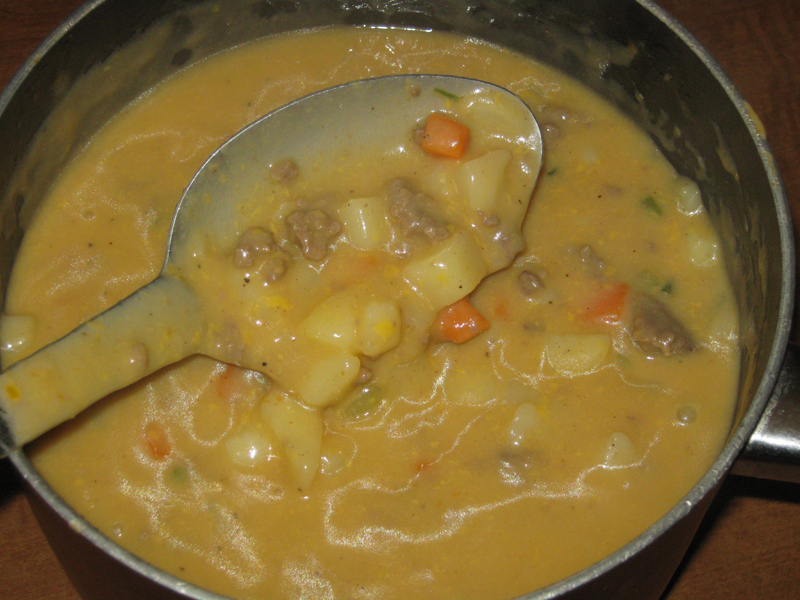
Cheese Burger Soup recipe marissabaker.wordpress.comAh, the fall season — crisp weather, autumn leaves, ripe apples, nasty allergies, and warm soup. This soup began life as a way-too-cheesey potato soup, and has now settled down as a meat soup with respectable levels of cheese.

A bit of bloggish news: I’ve added a recipe book page. It has all the recipes I’ve posted in one convenient, organized location so you can easily find what you’re looking for. I’ll keep it updated as I post new recipes.

Cheese Burger Soup

print this recipe

Cheese Burger Soup recipe marissabaker.wordpress.com
les légumes

5 medium potatoes, peeled and cubed (about 4 cups)

1 large carrot, finely chopped (about 1 cup)

1/2 stalk celery, finely chopped (about 1/4 cup)

2 cups water

2 cups beef broth

1/2 pound ground beef, cooked

Combine all ingredients and bring to a boil; reduce heat. Cover and simmer until the potatoes are tender (15 – 20 minutes. Add ground beef.

Cheese Burger Soup recipe marissabaker.wordpress.com
bringing to a boil

6 Tbsp. butter, melted

6 Tbsp. flour

3 tsp. steak seasoning (see recipe below)

2 cups of shredded cheese (cheddar or a mixture of different types)

In a small bowl, combine ingredients except cheese. Stir into soup, increase heat to medium and cook, stirring until thick and bubbly. Remove from heat and stir in cheese until melted. Let stand 5-10 minutes before serving.

Steak Seasoning

Cheese Burger Soup recipe marissabaker.wordpress.com
ready to eat

2 teaspoons salt

1 teaspoon paprika or chili powder

1/2 teaspoon black pepper

1/4 t teaspoon onion powder

1/4 teaspoon garlic powder

1/4 teaspoon . cayenne or chipotle powder

1 dash each coriander and tumeric (optional)

Combine all and place in a container.

print this recipe

Fictional MBTI — Loki

Update: Click here for a newer post about Loki with a more complete type analysis.

Over the past couple weeks, without even looking for them, I’ve stumbled upon two blogs talking about Myers-Briggs types for fictional characters. One is a Tumbler called MBTI in Fiction. The other is a blog titled A Little Bit of Personality, with a series of posts analyzing heroic archetypes.

I’ve been intrigued by the characters each of these writers choose to type as INFJs. Neither of these writer’s are INFJs themselves (the writer from “MBTI in Fiction” is an ENTJ and the writer of “A Little Bit of Personality” is an ENTP), and it’s interesting to see who non-INFJs think are INFJs. I don’t always agree with them, but it’s interesting.

Loki

Fictional INFJs -- Loki. marissabaker.wordpress.comThis was the first post I saw from MBTI in Fiction. My initial reaction was, “There’s no way Loki and I have the same personality type.” But I agree that he’s an introvert, and I don’t think he’s logical or grounded enough to be either an S or a T type, so that leaves us with INFJ or INFP. (Some people type him as an INTJ Mastermind, but he seems to rely on Extroverted Feeling more than Extroverted Thinking as a function).

Both INFJs and INFPs feel everything very deeply and trust their intuition. However, INFPs tend to keep their emotions to themselves, though feelings will inform all their actions. Outwardly, they appear “receptive and non-judgmental.” INFJs prefer to approach the world through Introverted Intuition (Ni), followed by Extroverted Feeling (Fe). They are the rarest type, often question their sanity,  rely strongly on their intuitions about people, and tend to talk about their feelings. Dr. A.J. Drenth’s profile includes this descriptions, which I think sounds a lot like Loki (as played by Tom Hiddleston in The Avengers):

INFJs are far less serious inwardly than they may appear outwardly. Their inner world is well described as playful, imaginative, colorful, mischievous, and daring. Characterized by Perceiving rather than Judging, it is far less controlled and regulated than that of INFPs. INFJs love playing with ideas, perspectives, theories, images, symbols, and metaphors.

Another reason I’ve been won-over to typing Loki as an INFJ is because of the description of INFJ villains on A Little Bit of Personality’s page. It really does sound like Loki, and the last line hits a little too close to home for me to brush this analysis off as written by someone who just doesn’t understand INFJs.

When turned to villainy, the INFJ is *creepy*! There isn’t really any other word for it. Dark Paladins are the best of manipulators because they are incredibly intuitive about people and can apply their mild-manneredness to going under the radar as long as they need to, manipulating others who would never suspect them. Because they are so good at this and *know* it, pure-hearted INFJ’s often wonder if they are secretly evil and manipulative at heart, like one day they’ll wake up and realize they were bad all along.

Future Posts?

I was planning on covering several characters, but after I started writing Loki I decided one would be enough for a single post. Maybe I’ll write more at some other time, if anyone is interested. Are there any characters you’ve been thinking are INFJs? Would you be interested in me typing non-INFJ characters?

Save

Bad Girls of the Bible

I’ve been reading a series of three books by Liz Curtis Higgs titled Bad Girls of the Bible, Really Bad Girls of the Bible, and Slightly Bad Girls of the Bible. The first book was decided upon for a book club at church, and once I’d finished it I tracked down the other two from the library. Higgs’ writing style is a little more informal than I usually like (I found myself skipping some of her “Lizzie style” commentary), but I like the short fictionalized stories that begin each chapter and bring the woman’s story into a modern setting. I also appreciate spending an entire chapter discussing the Biblical accounts verse-by-verse, and sometimes even word-by-word, since I don’t always take the time I should to really think about the people in the Bible. I’ll talk about the first two books in the series now, but I have enough to say about Slightly Bad Girls that I think I’ll save it for another post.

Bad

Higgs’ reason for studying less-than-perfect women is that they can “show us how not to handle the challenges of life.” They can also be more relatable than women who seem perfect, and studying the weaknesses we share with women who stumbled can help us avoid pitfalls in our own lives.

The women discussed in this book are Eve, Potiphar’s Wife, Lot’s Wife, The Woman at the Well, Delilah, Sapphira, Rahab, Jezebel, Michal, and The Sinful Woman. I was really impressed with the fiction in this book. Eve becomes a sheltered rich girl, Delilah is a hairdresser, and Lot’s Wife a woman who refuses to leave her home near Mount Saint Helens. The fiction story for the Woman at the Well isn’t quite as well done, but it’s hard to come up with a modern fictionalized character to stand-in for Jesus so I think we’ll cut the author some slack.

Really Bad

I read these books slightly out of order, so this is the one I just finished. The title is a little misleading — it’s more like additional bad girls, rather than girls who are worse than those in the last book. Higgs describes the difference between the two books like this:

If the first Bad Girls of the Bible was all about grace, this second one is all about the sovereignty of God, the unstoppable power of God to accomplish his perfect will, no matter how much we mess up.

This book covers the Medium of En Dor, Jael, The Adulteress, Athaliah, Bathsheba, Herodias, Tamar, and The Bleeding Woman. What struck me most about this book was the Bleeding Woman’s story (from Matt. 9:20-22; Mark 5:25-34; Luke 8:43-48). This woman was bleeding for twelve years — that’s 4,380 days, plus a few extra for leap years. According to Levitical law, she was ceremonially unclean the entire time (Lev. 15:19-27). She couldn’t touch anyone, and probably had to live alone because everything she came in contact with became unclean. Can you imagine people not even wanting to be in the same house as you for twelve years? I like solitude as much as the next introvert, but that’s way too much alone-time.

When Jesus healed her, He took away not only her physical infirmity, but also her separation from other people. And He talked to her in public — not something teachers normally did with women, especially women who were still ceremonially unclean (Lev. 15:28-30). She is also the only woman in the Gospels who Jesus calls “daughter.” What an incredible story!