3 Keys to Biblical Motherhood

I wasn’t quite sure what today’s post would be about until I’d been working on it for nearly a week. I knew I wanted to look at motherhood in the Bible, then as I studied three things gradually stood out to me as key points the Biblical writings emphasize. Society often places a ton of pressures on mothers to be perfect, and in the church it’s often described as the most important thing a woman can do.

For most of my life, when I studied women’s roles in the Bible and in the church, I was trying to find hints for what is expected of unmarried women without children. That’s a bit challenging, because instructions are often addressed to wives or talk about children. Now that I’m married and pregnant, though, all those verses are suddenly more relevant. I find it encouraging to study the Bible and see God really expects three basic things from mothers: pray for their kids, love their kids, and teach/train them in God’s way of life.

Image of a woman's and a toddler's feet overlaid with text from Psalm 127:3, WEB version: "Behold, children are a heritage of Yahweh. The fruit of the womb is his reward."
Image by Brimstone Creative from Lightstock

Praying For Children

I’ve long been fascinated by God’s interactions with the patriarch’s wives. He’s called the God of Abraham, Isaac, and Jacob, but He’s also the God of Sarah, Rebecca, Leah, and Rachael and we have record of Him interacting with the women as well as the men (God spoke directly with Sarah and Rebecca [Gen. 18:9-15; 25:20-26] and Leah’s name choices imply a relationship with Him [Gen. 29:31-35]) . Interestingly, all these interactions are related to their roles as mother. God definitely talks to and works with women who aren’t mothers as well, but for many women who talked with God, their interactions with Him involve their children. Either they’re asking for a child, or God’s telling them they’ll have a child, or they’re seeking God’s help with a child.

Christians are under no obligation to get married or have kids if they don’t want to (there are even verses where Paul counsels it could be best to remain single), but the Bible assumes that the majority of people will marry and that they’ll want to have kids. As we discussed in last week’s post, God loves children and He cares deeply about how His people raise the children that He gives to them as a gift.

She was in bitterness of soul, and prayed to Yahweh, weeping bitterly. She vowed a vow, and said, “Yahweh of Armies, if you will indeed look at the affliction of your servant and remember me, and not forget your servant, but will give to your servant a boy, then I will give him to Yahweh all the days of his life, and no razor shall come on his head.” …

When she had weaned him, she … brought the child to Eli [the priest]. She said, “Oh, my lord, as your soul lives, my lord, I am the woman who stood by you here, praying to Yahweh. I prayed for this child, and Yahweh has given me my petition which I asked of him.”

1 Samuel 1:10-11, 24-27, WEB

I love that God listens to women’s prayers or even just thoughts for and about their children. We see this first in Hagar’s story, where she was clearly worried about her son but doesn’t even have to make a specific prayer for God to respond to her plight (Gen. 16:6-15; 21:8-21). We see it in Rebecca, who had a question about her pregnancy that God personally responded to (Gen. 25:20-26). We see it in Hannah (whose story I just quoted), who asked God for a son and received exactly what she requested (1 Sam. 1:1-2:11). From the many examples of praying mothers in the Bible and God’s careful attention to their prayers, we can see that praying for children is a key part of Biblical motherhood.

Image of a mother coloring at a table with her son and daughter, overlaid with text from Prov. 1:8-9, WEB version: "My son, listen to your father’s instruction, and don’t forsake your mother’s teaching: for they will be a garland to grace your head, and chains around your neck."
Image by Brimstone Creative from Lightstock

Teaching Your Children

My husband and I were both homeschooled, and we’re planning to homeschool our children as well. I’m so excited about this, particularly now that I have teaching and tutoring experience working with everyone from 5-year-old beginning readers to teens struggling with homework to Ph.D. candidates looking for editing help on their dissertations. I love teaching and I’m excited to teach my children and discover their learning styles.

One of the things that the Bible assumes (and commands!) is that fathers and mothers will both be teaching, training, and disciplining (disciple-ing) their children. When we look at Moses’s words in Deuteronomy about passing on God’s teachings to children, we can remember that his audience was “all Israel” (Deut. 1:1; 5:1). That’s the whole assembly of the congregation, men and women.

Therefore you shall lay up these words of mine in your heart and in your soul. You shall bind them for a sign on your hand, and they shall be for frontlets between your eyes. You shall teach them to your children, talking of them when you sit in your house, when you walk by the way, when you lie down, and when you rise up. You shall write them on the door posts of your house and on your gates; that your days and your children’s days may be multiplied in the land which Yahweh swore to your fathers to give them, as the days of the heavens above the earth.

Deuteronomy 11:18-21, WEB

When you have kids, God expects you to make His way of life part of their everyday learning. Even if you don’t homeschool, you’re still responsible for teaching your children the word of the Lord. That goes for both mothers and fathers.

My son, keep your father’s commandment,
    and don’t forsake your mother’s teaching.
Bind them continually on your heart.
    Tie them around your neck.

Proverbs 6:20-21, WEB

Mothers taught both boys and girls (for example, all of Proverbs 31 is “The words of king Lemuel; the revelation which his mother taught him). There’s a good chance that Jesus’s mother Mary was His primary teacher, since she was from a priestly family and spent time in the home while Joseph would have been busy with his work as a carpenter (Metsämuuronen, 2019). Jewish children of Jesus’s time grew up steeped in religious tradition, learning prayers, keeping Sabbath and the feasts, and eating kosher foods. They were likely taught “the contents of the main scriptures and proverbs” and learned how to “read something” from their mothers before beginning formal schooling at the age of six or seven (Metsämuuronen, p. 5). If there was a local synagogue, both boys and girls would have gone there to learn Torah until around age thirteen. If not, it was the parents’ responsibility to continue their schooling.

Teaching and training children in God’s way of life is still a responsibility for parents, regardless of how else their children are being taught things more traditionally considered school subjects. It’s not something we can leave to chance or hope they learn through osmosis at church or from our examples. We need to be intentional about it. As such an important responsibility, teaching and training children is a key aspect of Biblical motherhood.

Love the Children

Image of a mother sitting by a lake with two little girls, overlaid with blog's title text and the words, "Reading the scriptures shows God expects three basic things from mothers: to pray for their kids, to love their kids, and teach them His way of life."
Image by Anggie from Lightstock

Praying for their children is something we see mothers in the Bible do. Teaching their children is something they were commanded to do. Another command, which involves older mothers teaching new mothers, is to love our children.

But as for you, communicate the behavior that goes with sound teaching. … Older women likewise are to exhibit behavior fitting for those who are holy, not slandering, not slaves to excessive drinking, but teaching what is good. In this way they will train the younger women to love their husbands, to love their children, to be self-controlled, pure, fulfilling their duties at home, kind, being subject to their own husbands, so that the message of God may not be discredited.

Titus 2:1, 2-5, NET

It seems a little odd that the older women have to train the younger women how “to love their children.” We tend to think that love is something that just happens and people don’t need to work on it, especially for women with their maternal instinct. There are also hints in the Bible that it’s natural and normal for women to cherish their own children (Is. 49:15-16; 1 Thess. 2:7). But just like we learn to love a spouse more fully and deeply (rather than simply settling for impulsive, romantic love), we can also learn how to love our children better.

I know there’s a lot involved in being a good mother, but I suspect most of it is going to fall into these broad categories (based not just on Bible study, but practical observations of and conversations with mothers I know and admire). It’s kind of like how the entire law is fulfilled by truly following the command to love God and love your neighbor (Matt. 22:35-40; Rom. 13:8-10). If we’re praying for our children, teaching them God’s way, and loving them truly, then maybe the rest is simply details on how to do that properly.


Featured image by Pearl from Lightstock

2023 On My Blog: A Year-End Review

It’s time for my year-end tradition of a blog review. It’s partly for me, to look back and see what people were most interested in reading, and partly to share with you all what’s been going on in the blog you’ve been following, reading, and commenting on this past year.

The big news on the blog this year was that I finally launched an email newsletter. I send out a short email every other week with an update or message, and a brief recap of the blog posts published between newsletters. If you choose to sign up, it’s a great way for us to keep in touch and you’ll also receive a free copy of my book God’s Love Story.

You can click here to see WordPress’s official summary of 2023 on LikeAnAnchor.com. According to those stats, there were 220,714 page views last year, 289 likes, and 79 comments. That’s not the whole story of the blog, though, so here are some of the stats I that I can see with my behind-the-scenes stats.

10 Posts With The Most Traffic

These ten posts were the most popular on my blog this past year. The top one had 7, 605 views!

  1. When God Calls You By Name
  2. What Do Other People Think of INFJs?
  3. Dating Your Mirror: ENFP and INFJ Relationships
  4. Water, Spirit, Fire: The Three Baptisms of Christianity
  5. How Do Other People See INTJ Personality Types?
  6. INFJ Dark Side
  7. How To Tell If An INFJ Likes You?
  8. Religion and the INFJ
  9. How Do I Know If I’m an INFJ or an ENFJ?
  10. 5 Relationships Problems INFJs Often Struggle With

Top Posts From 2023

Older posts tend to get the most traffic, partly because they’ve been on the site longer and partly because my INFJ content still trends well in search engines. With that in mind, I also like to share the most popular posts published within this past year. Obviously this favors posts published earlier in the year, since they had more time to collect visitors, but I still think it’s interesting to look at them.

  1. The Crown of Victory
  2. A Closer Look At The Role of Pastors and Shepherds
  3. What Can We Learn from Shepherd, Sheep, and Lamb Imagery in the Bible?
  4. The Women at Pentecost: Valuing the Contributions of Unnoticed People in Church
  5. What If The Proverbs 31 Woman Was Less Intimidating?
  6. Relational Faith: A Book Review and Theological Reflection
  7. Building People Up in Christ
  8. Jesus as the Originator and Trailblazer: A Study of Archegos
  9. Witnesses in the Book of Acts
  10. The Glory, Importance, and Victory of Other People

5 Most Popular Scripture Writing Plans

Several years ago, I added 30-day scripture writing plans to the resources available on here on Like An Anchor. You can see them all and download them for free by clicking here. These were the most popular in 2023 (ranked by numbers of downloads):

  1. Inspiring Music
  2. Double Minded
  3. Self Control
  4. Compassion
  5. Big Questions

An honorable mention goes to my chart outlining God’s holy days, which isn’t a scripture writing plan but was the second-most downloaded resource on my blog this year.

Countries With Over 4,000 Visors

I’m always amazed by how many people visit my blog from all over the world. To give you all a glimpse into where your fellow readers are located, here’s a list of the countries home to at least 4,000 blog visitors this past year (I always choose a number as a cut off point for this list, simply for the sake of length).

  1. United States
  2. United Kingdom
  3. Canada
  4. India
  5. Philippines
  6. Australia
  7. Germany
  8. Nigeria
  9. South Africa
  10. Indonesia

A big “thank you” to everyone around the world who subscribes to the blog, reads my posts, and/or takes the time to comment or send me an email. I literally couldn’t/wouldn’t be doing this without your support! May you all have a blessed 2024.

Featured image by Mohamed Hassan from Pixabay

Putting “Spare the Rod” In Context

I’ve been reading through Proverbs in the evenings lately, and recently one of the verses about disciplining children caught my eye. There are several, but this one reads, “Folly is bound up in the heart of a child: the rod of discipline drives it far from him” (Prov. 22:15, WEB). As I read this, I wondered if rather than a rod for beating this might refer to a rod like shepherds use, as in “Your rod and your staff, they comfort me” (Ps. 23:4, WEB).

When we think about this topic, you might be more familiar with the phrase, “spare the rod, spoil the child.” This isn’t actually in the Bible but comes from a 17th-century poem by Samuel Butler called “Hudibras” where the context is whipping a lover to “raise passion.” How that particular poem ended up associated with Proverbs (to the point that I found an article published in an academic journal misquoting this phrase as Prov. 13:24) is a befuddling mystery. The Proverb with the closest phrasing reads, “One who spares the rod hates his son, but one who loves him is careful to discipline him” (Prov. 13:24, WEB).

Despite the phrase confusion with Butler’s poem, there are Proverbs about rods of discipline and children. In addition to the two we looked at, there’s also “Don’t withhold correction from a child. If you punish him with the rod, he will not die. Punish him with the rod, and save his soul from Sheol” and “the rod of correction gives wisdom, but a child left to himself causes shame to his mother” (Prov. 23:13-14; 29:15, WEB). Historically, these have been used to justify corporal punishment, even in some cases things that today we’d (correctly, in many cases) label child abuse. But it clearly does recommend disciplining your children in some way, so we need to be careful not to go to the other extreme either and never discipline at all.

As I think about this, particularly now that I’m pregnant with a little baby of my own, I wonder what useful lessons we can learn from these proverbs. I want to take a closer look at their historical interpretation as well as the Hebrew words used. We’ll also look at other Bible verses that talk about interacting with children to put the verses from Proverbs in their larger context.

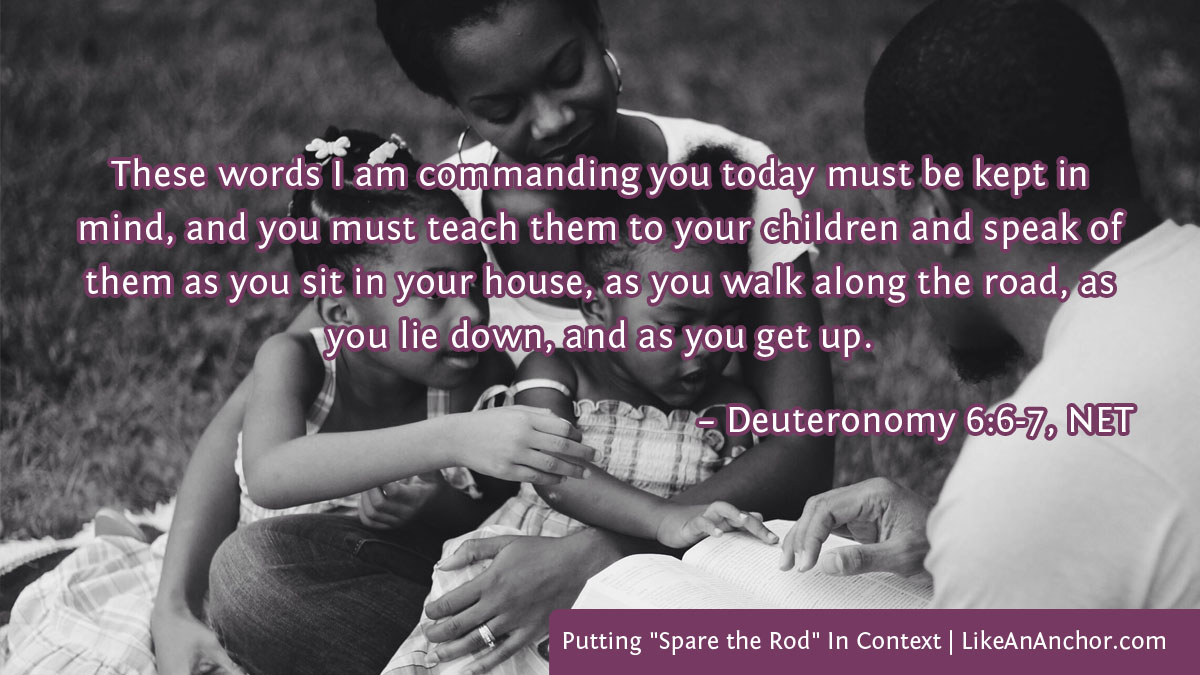
Image of a mom and dad reading to two little girls overlaid with text from Deut. 6:6-7, NET version: "These words I am commanding you today must be kept in mind, and you must teach them to your children and speak of them as you sit in your house, as you walk along the road, as you lie down, and as you get up."
Image by Marcus from Lightstock

Jewish and Early Christian Perspectives on Discipline

One of the things I wanted to start out with was trying to figure out how people of Jesus’s day might have interpreted these scriptures from proverbs. As I mentioned in my post a couple weeks ago about putting scripture in context, you can use Google Scholar to search for academic articles on pretty much any subject you like. For this topic, I searched “corporal punishment of children in first century judaism.” Not all the resulting articles were available to read for free, but I found a few that shed some light on this topic.

Ancient context for Proverbs

Beginning with the earliest textual evidence covered by the articles I found, John Fitzgerald (2008) examines texts from Sumerian, Assyria, and Egypt to put the Proverbs discussion into an ancient perspective. He assumes that the author of proverbs refers to beating children–particularly boys–with a literal rod, in the tradition of other ancient texts which discuss beating and caning students and even locking them up in stocks if they misbehaved. He cites Proverbs and the apocryphal Book of Sirach as evidence that “the practice of whipping one’s children for disciplinary purposes was widely practiced among the ancient Israelites and Second Temple Jews” (p. 301).

With those background assumptions established, Fitzgerald turns to a comparison of Proverbs 3:11-12 and Hebrews 12:5-6. In the Masoretic Hebrew text, this verse speaks of a father disciplining his children. In the Septuagint, quoted by the author of Hebrews, the text speaks of whipping a child. However, Fitzgerald does point out that the author of Hebrews “stresses sonship and discipline, not corporal punishment per se,” though he maintains painful punishment is implicit in the text (p. 313). It is interesting to compare the Biblical texts and Jewish writings with other cultural practices of the same time, but I do not think that the other texts can offer proof that Jewish families followed their neighbors’ example or that God expected them to. More often when God instructs His people on regarding the example of other nations, He’s saying not to do as they do (Deut. 12:29-31; Josh. 23:6-8). We can’t use the other ancient instructional texts as definite proof that the ancient Israelites practiced the same type or degree of corporal punishment (though there is evidence of corporal punishment being used in some way).

The New Testament period

On the topic of education of children in the New Testament period, Margaret Y. MacDonald (2012) points out in an introduction to “Special Issue on Children and Childhood in Early Judaism and Early Christianity” that examinations of early Christian ideas on children and childrearing should also take into context the Greek and Roman world of the time as well as Judaism. Particularly “for the first two centuries CE, the use of the categories of Judaism and Christianity is in many ways misleading and problematic” because there is so much overlap between the two traditions” (no page numbers). These overlaps between the two traditions include the Jewish and Christian “approach to education” and “emphasis on the authority of parents and obedience of children.”

One of the articles in this special issue examines the Dead Sea Scrolls for texts related to children’s education. In this article, Cecilia Wassen (2012) highlights that at least this one Jewish sect instructed a teacher called the Examiner “to teach the children ‘[in a spi]rit of hu[mi]lity and lov[ing-kindness]’ and ‘not keep a grudge against th[em] with wrathful an[ger]’” (p. 357, brackets in original). This case where a teacher was “admonished to be gentle to his young students is a sharp contrast to Roman teaching methods and to one case from the Mishna (a written collection of Jewish oral traditions) where a teacher “who had beaten a student to death” was absolved from guilt (p. 357). It appears that in the first century, much like today, there were sharp differences in interpretations of the Biblical instructions to train up children to follow God’s way of life. Some teachers were admonished to be gentle and exercise loving kindness, while others were allowed to beat children.

Modern views on discipline

Taking a more modern look at this topic, Tamar Morag (2011) examines current laws on corporal punishment in the United States and Israel through a historic-religious lens, arguing that Puritan and Protestant interpretations of the Bible have protected parental rights to physically punish children in the U.S. while Jewish interpretations have moved away from corporal punishment. For the U.S., historic interpretations were largely driven by the notion of original sin and the need for punishment and correction to drive evil out of the child. That view isn’t really found in Judaism, and educators in Israel have different views on the verses in Proverbs.

Morag cites Yitzhak Levi, a minister of education writing in 1993, and his interpretation of the verse “He that spares his rod hates his son, but he that loves him chastises him early.” Levi wrote that, “‘love’ and not ‘hate’ is the higher virtue. What does ‘he who loves’ do? He . . . knows how to anticipate things so that he will not need to use the rod. This educational approach is better, and conveys love for the child” (qtd. in Morag, p. 355-6). Another writer, this time a judge, concluded that “rod” refers to “tongue-strapping” (p. 357). That’s not to say there aren’t any interpretations of these verses in modern Judaism that support corporal punishment, but it is the interpretations against physical punishment that became law in modern Israel.

Citations:

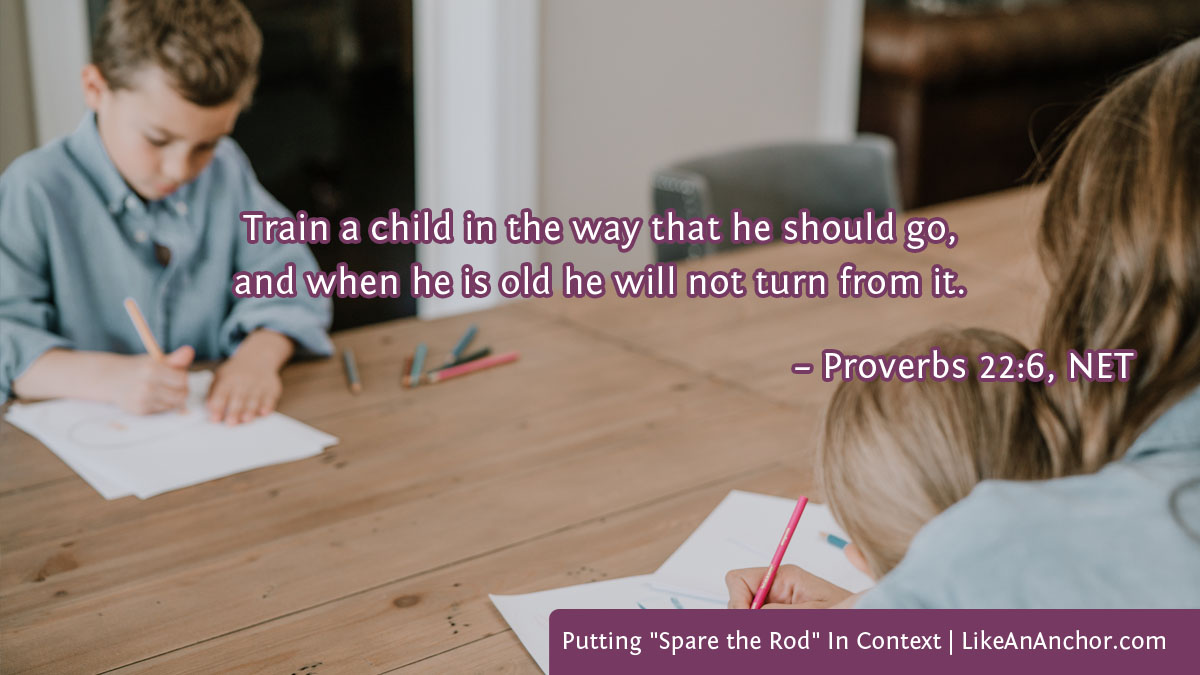
Image of a mom drawing with her daughter and son overlaid with text from Prov. 22:6, NET version: "Train a child in the way that he should go, and when he is old he will not turn from it."
Image by Brimstone Creative from Lightstock

What is a “Rod”?

In Morag’s article comparing religious influence on laws regarding corporal punishment of children in the United States and Israel, she blames Puritan/Protestant emphasis on “abiding by the literal text of the Scriptures” for the focus on physically punishing children (p. 348). Perhaps it’s my own U.S. Christian upbringing influencing this, but I also think there is great value in taking the Bible at face-value and interpreting (at least parts of it) literally. However, being able to do that depends on a few things. First, we need to determine if the author intended the passage to be literal (as there are plenty of figurative and allegorical things in the Bible). Second, we need to be working with a correct translation.

The literal meaning of an English word does not necessarily match the literal meaning of a Hebrew word it’s translating, particularly when the Hebrew carries nuances not present in English. Our cultural and linguistic biases could also get in the way, and something we might think is a literal interpretation of scripture could be far off from the original meaning. For example, the KJV “Thou shalt beat him with the rod, and shalt deliver his soul from hell” (Prov. 23:14) could be read as corporal punishment keeping children from an ever burning hellfire, but in Hebrew the word sheol simply means “the land of the dead” (Morag p. 348). This verse is about discipling a child so they’ll live and not die, rather than commenting on the eternal fate of the child’s soul. In this case, a translation choice and assumptions made about the afterlife dramatically change the potential “literal” readings of the passage.

In the book of Proverbs, the verses that speak of disciplining a child with a “rod” use the Hebrew word shêbeṭ (H7626). This is an interesting word with a range of meanings including “rod, staff, branch, offshoot, club, sceptre, tribe” (Brown, Driver, Briggs). It is also the same word used of a shepherd’s rod in Psalm 23. Depending on the context, it can refer to a rod for correction, a weapon, a shepherd’s tool, or a ruler’s scepter as a mark of authority (Theological Wordbook of the Old Testament [TWOT] 2314a). The TWOT highlights a connection between smiting and ruling authority. They also state that the use of shêbeṭ in Proverbs is as “the symbol of discipline, and failure to use the preventative discipline of verbal rebuke and the corrective discipline of physical punishment will end in the child’s death.” Though “rod” is a perfectly acceptable translation, I can’t help but wonder how different our modern English interpretations of these proverbs might be if an early translator had decided that “authority to correct” was a better translation than “rod.”

In the verses that speak of beating with this rod, the word for “beat” is nâkâh (H5221). It basically means “smite, strike, hit, beat, slay, kill,” with a range of meanings that include a single slap on the face, clapping hands before a king, beating or scourging as punishment, or even to strike someone dead in warfare, murder, or by accident (TWOT 1364). Again, I wonder how our views on this topic might be different today if the KJV translators had said something like “Don’t withhold correction from a child, for if you slap him with your authority to discipline, he will not die” rather than “Withhold not correction from the child: for if thou beatest him with the rod, he shall not die” (Prov. 23:13, KJV).

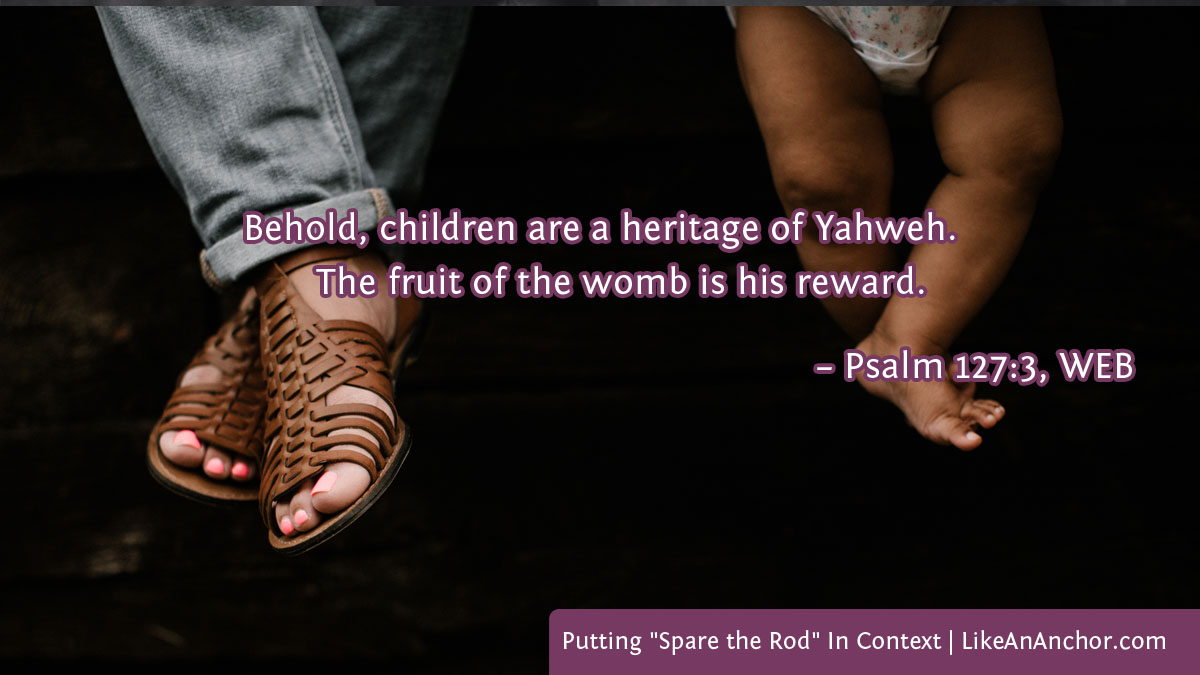
Image of a woman's and a child's feet as they sit together overlaid with text from Psalm 127:3, WEB version: "Behold, children are a heritage of Yahweh. The fruit of the womb is his reward."
Image by Brimstone Creative from Lightstock

Contextualizing the Verses About Children

So far, we’ve looked at historic and linguistic contexts for the verses in Proverbs. Now, let’s look at them in relation to other Bible verses that talk about how parents ought to relate to children. Interestingly, Proverbs is the only book that talks about using a rod on your children. Overall, the Biblical emphasis is on teaching and good discipline. There are a lot of scriptures in this section, but I think quoting them all rather than just summarizing them will be the best way to get a clearer picture of the Biblical teachings on this topic.

Hear, Israel: Yahweh is our God. Yahweh is one.  You shall love Yahweh your God with all your heart, with all your soul, and with all your might. These words, which I command you today, shall be on your heart; and you shall teach them diligently to your children, and shall talk of them when you sit in your house, and when you walk by the way, and when you lie down, and when you rise up. 

Deuteronomy 6:4-7, WEB

Train up a child in the way he should go,
    and when he is old he will not depart from it.

Proverbs 22:6, WEB

Foolishness is bound up in the heart of a child,
but a rod of discipline will drive it far from him.

Proverbs 22:15, TLV

Don’t withhold correction from a child.
    If you punish him with the rod, he will not die.
Punish him with the rod,
    and save his soul from Sheol.

Proverbs 23:13-14, WEB

A rod and reproof impart wisdom,
but a child who is unrestrained brings shame to his mother.

Proverbs 29: 15, NET

Children, obey your parents in the Lord, for this is right. Honor your father and mother,” which is the first commandment accompanied by a promise, namely, that it will go well with you and that you will live a long time on the earth.”

Fathers, do not provoke your children to anger, but raise them up in the discipline and instruction of the Lord.

Ephesians 6:1-4, NET (bold italics mark quotations from Exod 20:12 and Deut 5:16)

Children, obey your parents in everything, for this is pleasing in the Lord. Fathers, do not provoke your children, so they will not become disheartened.

Colossians 3:20-21, NET

As you know, we treated each one of you as a father treats his own children, exhorting and encouraging you and insisting that you live in a way worthy of God who calls you to his own kingdom and his glory.

1 Thessalonians 2:11-12, NET

This saying is trustworthy: “If someone aspires to the office of overseer (episkopos, bishop, church leader) , he desires a good work.” The overseer then must be above reproach … He must manage his own household well and keep his children in control without losing his dignity.

1 Timothy 3:1-2, 4, NET

say the things which fit sound doctrine, … that older women [should be] … teachers of that which is good, that they may train the young wives to love their husbands, to love their children,

Titus 2:1, 3-4, WEB

We could also look at other verses that show the high value God places on children. In the Old Testament, God was horrified and disgusted that people would even think of killing their own children in sacrifice to other gods, and He strictly forbid it (Lev. 18:21; Deut. 12:30-31; Jer. 19:4-5). He notices children even when they’re inside the womb (Gen. 25:22-24; Ps. 71:5-6; 139:13; Is. 44:2; Jer. 1:4-5). Scripture also teaches God’s people that we should see our children as a gift that comes from Him (Gen. 33:5; Psalm 127:3-5).

When His disciples tried to keep babies and children from coming to Jesus, He rebuked them and welcomed the little ones (Matt. 19:13-15; Luke 18:15-17). Peter pointed out that God is granting repentance and giving the promise of the Holy Spirit not only to those He calls, but to their children as well (Acts 2:39). Paul told us that the Lord sees His people’s children (even if they only have one believing parent) as holy to Him (1 Cor. 7:14). Children are precious in God’s eyes, and He cares deeply about how we treat our own children and other children we come into contact with. Most especially, He wants us to teach our children His way of life for their benefit.

Concluding Thoughts

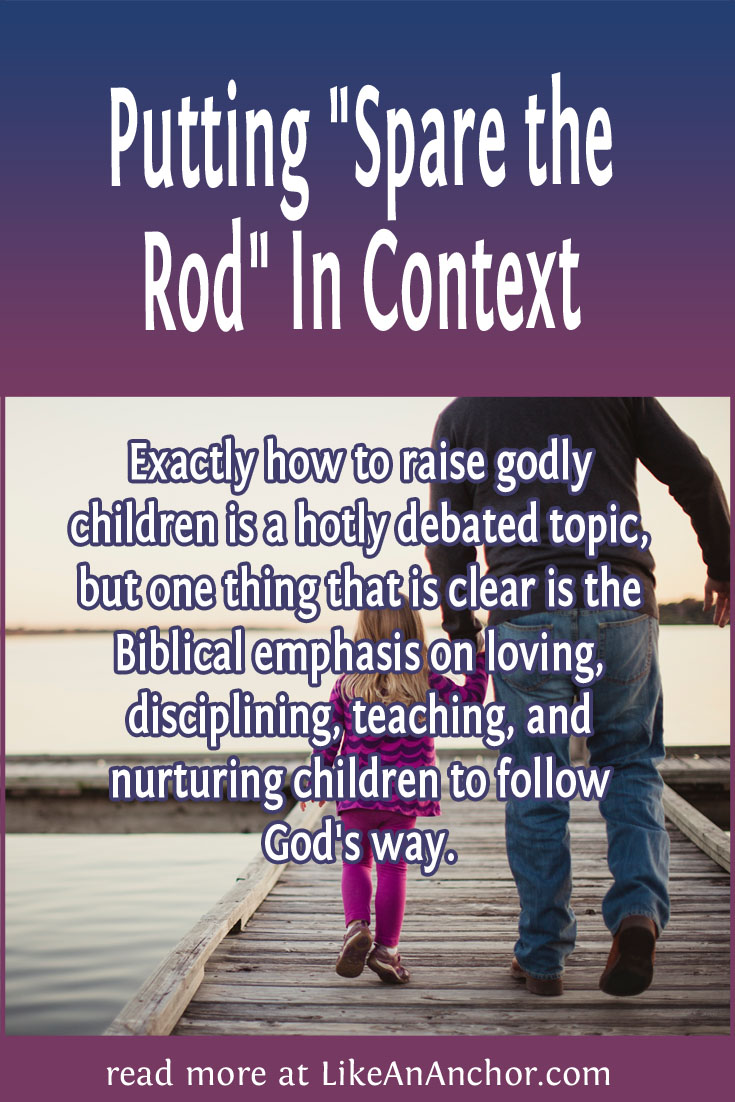
Image of a dad holding a little girl's hand as she walks, overlaid with blog's title text and the words, "Exactly how to raise godly children is a hotly debated topic, but one thing that is clear is the Biblical emphasis on loving, disciplining, teaching, and nurturing children to follow God's way.
Image by Shaun Menaryfrom Lightstock

Without the verses in Proverbs, we might not even think the Bible allows or encourages corporal punishment. The emphasis overall is on guiding, teaching, and nurturing children to follow God’s way. Discipline is a key part of that, but discipline that is in keeping with love and does not anger or discourage children. The proverbs verses serve more, I think, to show that the Bible teaches certain types of corporal punishment can be included in discipline when appropriate rather than to say everyone should beat their children.

Clearly, the degree to which corporal punishment should or can be used is an ongoing debate and has been for centuries. The Essenes sect responsible for the Dead Sea scrolls advocated gentle teaching and correction methods, while another Jewish group absolved from guilt a teacher who beat his student to death (Wassen, 2012). Some Bible verses talk about discipline and instruction of children without mentioning corporal punishment, while proverbs of Solomon advocate it as an option (though I think it’s also worth mentioning that Solomon’s child we have details about didn’t turn out so great [1 Kings 11:43-12:19]).

That there should be clear expectations for behavior and logical consequences for disobedience is borne out by psychological research into child development. This research “consistently finds that logical consequences are related to improved behavior and mental health in children” (Psychology Today, “When Gentle Parenting Doesn’t Work”). It’s also in keeping with Biblical admonitions like, “Train a child in the way that he should go, and when he is old he will not turn from it” (Prov. 22:6, NET). I also think the type of discipline used should take the individual child into account. For me, I really didn’t care if I was spanked, but if Dad looked disappointed or Mom took away my books for a day those were meaningful consequences. In contrast, you can also find people who say they were glad their parents spanked them because that was the consequence that made sense to them.

If you were looking for a clear answer like “here’s exactly how you should discipline and raise children in a godly way,” I’m afraid I don’t have that. I’m also not here to make public my and my husband’s decisions we’re making about child rearing. I just wanted to study this topic this week, and share some food for thought. God places a high emphasis on parental responsibility, which includes teaching your children about His way and raising them to follow Him, as well as studying to determine how that should be done. It’s a weighty, precious responsibility.


Featured image by David Clark Photography from Lightstock

So Many Reasons to Praise

When we think of ways to deepen our relationship with God, we often think of things like Bible study, prayer, scripture-based meditation, and fasting. That’s what I typically hear are the best “tools” for connecting with God. As vital as those are, I think we could add “praise” to that list as well.

Through him then let us continually offer up a sacrifice of praise to God, that is, the fruit of our lips, acknowledging his name.

Hebrews 13:15, NET

Is anyone among you suffering? He should pray. Is anyone in good spirits? He should sing praises.

James 5:13, NET

The type of praise James mentions is relatively easy for us. When we’re happy and things are going well, it’s easy to praise God (provided we remember that He’s the one to thank for our blessings). But the author of Hebrews also says we should continually offer up praise to God as a type of sacrifice. That can be a little bit harder. We might fall into a routine of thanking and praising God for the same things in our life, and not be sure what else to add. Or we might be in a season where there doesn’t seem to be anything in our lives to praise God for.

The psalms provide a wealth of ideas for reasons to praise God, and many of them have nothing to do with our personal circumstances. Keeping these in mind can be helpful whether we’re struggling to praise, or if we’ve simply fallen into a routine and want to connect more deeply with Him.

Praise His Name

In the WEB translation (which is my favorite to use for Old Testament), there are 28 verses in psalms that speak of praising God’s name (out of a total of 151 uses of “Praise” in the whole book).


I will give thanks to Yahweh according to his righteousness, and will sing praise to the name of Yahweh Most High.

Psalm 7:17, WEB

Sing to God! Sing praises to his name! Extol him who rides on the clouds: to Yah, his name! Rejoice before him!

Psalm 68:4, WEB

From the rising of the sun to its going down, Yahweh’s name is to be praised.

Psalm 113:3, WEB

let them praise Yahweh’s name,
    for his name alone is exalted.
    His glory is above the earth and the heavens.

Psalm 148:13, WEB

One of the main reasons to praise the Lord is because He is worthy of it (Ps. 18:3). His nature, name, and reputation should inspire us to praise Him.

Image of a happy man playing piano overlaid with text from Psalm 135:3, WEB version: "Praise Yah, for Yahweh is good. Sing praises to his name, for that is pleasant."
Image by Ben White from Lightstock

Praise Because He Deserves Respect

If we respect God, revere Him, and live righteously, then the psalms present praise as a natural response. Those who fear God praise Him. Those who are righteous do as well. When we’re living godly lives, praise is a natural “fruit of our lips” (Heb. 13:15).


You who fear Yahweh, praise him! All you descendants of Jacob, glorify him! Stand in awe of him, all you descendants of Israel!

Psalm 22:23, WEB

For Yahweh is great, and greatly to be praised!
    He is to be feared above all gods.

Psalm 96:4, WEB

Sing praises to God! Sing praises!
    Sing praises to our King! Sing praises!
For God is the King of all the earth.
    Sing praises with understanding.

Psalm 47:6-7, WEB

I find the phrase “sing praises with understanding” such an interesting instruction. I think sometimes people idealize a sort of blind faith that loves God without wanting to make sense of Him, but God doesn’t expect or want us to be content with something so shallow. He wants to teach us and grow us, and as we mature we should learn to understand Him more and more. That understanding will fuel our praise, for the more we understand Him the more we’ll recognize how worthy He is of our praise.

Image of a woman standing on a mountain with her arms raised in praise, overlaid with text from Psalm 48:1, WEB version: "Great is Yahweh, and greatly to be praised, in the city of our God, in his holy mountain."
Image by Ruby-Rose from Lightstock

Praise for His Words

In addition to praising God for who He is, we can also praise Him for what He does. One of the great things that He does, which we all benefit from, is share His instruction with us. The Bible uses several different words to describe instruction from God, including words, ordinances, and statues. The thing they all have in common is that it’s important for us to listen, hear and internalize, and obey when God speaks.

In God, I will praise his word.
    In Yahweh, I will praise his word.
I have put my trust in God.
    I will not be afraid.
    What can man do to me?

Psalm 56:10-11, WEB

Seven times a day, I praise you, because of your righteous ordinances.

Psalm 119:164, WEB

Let my lips utter praise, for you teach me your statutes.

Psalm 119:171, WEB

We should be thankful for the words God shares with us and the instruction He gives us. But I wonder how often we take the time to marvel at the fact that we can read the Bible, a book that God wrote through human beings and preserved through millennia. Today, most people can read the Bible in their own native language (and for those that don’t yet, organizations like Wycliff Bible Translators are working to make translations). For many of us, we have access to dozens of different translations and formats for reading God’s word. That is a great blessing, one that we should praise God for.

Image of folded hands on an open Bible, overlaid with text from Psalm 105:43-45, WEB version: "He brought his people out with joy, his chosen with singing. He gave them the lands of the nations. ... that they might keep his statutes, and observe his laws. Praise Yah!"
Image by Jantanee from Lightstock

Praise for Salvation and Redemption

Another wonderful thing that God has accomplished is our salvation. Do you ever just sit and think of how amazing that is? The Father and Jesus planned far in advance for Him to save humanity by coming to earth like us, living a perfect life, and then dying a horrible death. Without that intervention, we’d all die permanently. But because of His great love and grace, we’re offered the gift of eternal life. And as if that wasn’t enough, He also offers deliverance from physical dangers as well, which is another type of salvation the psalms speak of.


Why are you in despair, my soul? Why are you disturbed within me? Hope in God! For I shall still praise him for the saving help of his presence.

Psalm 42:5, WEB

He rescues me from my enemies.
    Yes, you lift me up above those who rise up against me.
    You deliver me from the violent man.
Therefore I will give thanks to you, Yahweh, among the nations,
    and will sing praises to your name.

Psalm 18:48-49, WEB


I will also praise you with the harp for your faithfulness, my God.
I sing praises to you with the lyre, Holy One of Israel.
My lips shall shout for joy!
My soul, which you have redeemed, sings praises to you!

Psalm 71:22-23, WEB

God’s deliverance, salvation, protection, and redemption are priceless gifts. Whether it’s the salvation happening on a spiritual level when we accept Jesus’s sacrifice and enter covenant with God, or it’s deliverance from enemies and dangers (physical or spiritual). The fact that God is Savior gives us many reasons to praise.

Image of a man reading the Bible in the woods overlaid with text from Psalm 148:4-5, WEB version: "Praise him, you heavens of heavens, you waters that are above the heavens. Let them praise Yahweh’s name, for he commanded, and they were created."
Image by HarveyMade from Lightstock

Praise His Kindness and Goodness

Closely related to praising God for His salvation and redemption is praising Him for His kindness and goodness. These are key aspects of His character that we benefit greatly from.

Because your loving kindness is better than life,
    my lips shall praise you.
So I will bless you while I live.
    I will lift up my hands in your name.
My soul shall be satisfied as with the richest food.
    My mouth shall praise you with joyful lips,

Psalm 63:3-5, WEB

Praise Yahweh, my soul!
    All that is within me, praise his holy name!
Praise Yahweh, my soul,
    and don’t forget all his benefits

Psalm 103:1-2, WEB

Let them praise Yahweh for his loving kindness,
    for his wonderful deeds for the children of men!
Let them exalt him also in the assembly of the people,
    and praise him in the seat of the elders.

Psalm 107:31-32, WEB

The Lord’s loving kindness drives Him to do marvelous things for humanity, even though we do not deserve it. Even the fact that we have water to drink, food to eat, and air to breathe is due to His loving kindness. As James says, “Every good gift and every perfect gift is from above, coming down from the Father of lights” (Jas. 1:17, WEB). If there’s anything in our lives to be thankful for, we have God to praise for that.

Image of a smiling woman with her hand lifted in praise overlaid with text from Psalm 106:1, WEB version: "Praise Yahweh! Give thanks to Yahweh, for he is good, for his loving kindness endures forever."
Image by Pearl from Lightstock

Praise His Power and Might

Another reason that we can praise God brings us back to the idea of praising Him for who He is as well as what He does. Yahweh our God has great power and might. We can praise Him for that greatness, and we can praise Him for how He choses to use His power.


Be exalted, Yahweh, in your strength, so we will sing and praise your power.

Psalm 21:13, WEB


The heavens will praise your wonders, Yahweh,
your faithfulness also in the assembly of the holy ones.

Psalm 89:5, WEB

Give thanks to Yahweh! Call on his name!
    Make his doings known among the peoples.
Sing to him, sing praises to him!
    Tell of all his marvelous works.

Psalm 105:1-2, WEB

When we think of God’s mighty acts of power, we realize that most of them are incredible demonstrations of His love for His people (though there are also mighty demonstrations of His judgment on sin). We can think of historical events like the creation of the world (Gen. 1-2), the parting of the Red Sea (Ex. 14), the Lord defended Judah against an invading army (2 Kings 18-19), or Jesus raising Lazarus from the dead (John 11). We can also think of miracles we’ve seen in our own lives or heard of from fellow Christians.

Image of a man and woman with their hands lifted in praise, overlaid with blog's title text and the words, "Praise is a way for us to connect with and glorify God. Whatever our current circumstances, we have many reasons to praise Him."
Image by Anggie from Lightstock

No matter what is going on in our lives right now, we have many reasons to praise. And when we’re not quite sure what to say, the Psalms provide us with ideas for how to phrase that praise. You also don’t need to confine yourself to the psalms; the word “praise” shows up 254 times in a search of the WEB translation, and just over 100 of those are in books other than psalms. You might find it an interesting study to go through those 254 uses (not all are about praising God, but most are).

Praise Yah!
    Praise God in his sanctuary!
    Praise him in his heavens for his acts of power!
Praise him for his mighty acts!
    Praise him according to his excellent greatness!
Praise him with the sounding of the trumpet!
    Praise him with harp and lyre!
Praise him with tambourine and dancing!
    Praise him with stringed instruments and flute!
Praise him with loud cymbals!
    Praise him with resounding cymbals!
Let everything that has breath praise Yah!
    Praise Yah!

Psalm 150, WEB

Featured image by PhotoGranary from Lightstock

How Do You Put Scriptures in Context?

A lot of times when we encounter something from the Bible, it’s an isolated verse or two. We read devotionals that focus on a couple passages. We do topical Bible studies and jump around between scriptures looking for ones that fit together. We listen to sermons that follow a similar pattern of linking connected scriptures together. And there’s nothing wrong with that. If you read a translation of the New Testament that highlights quotes taken from the Old Testament (like the NET, which puts direct quotes in bold italics and allusions to OT passages in italics), you’ll see that Jesus and the apostles frequently reference lines from much larger passages without explicitly addressing the context.

However, most of the people that Jesus and the apostles (at least those writing to Jewish audiences) were speaking or writing to were scripturally literate. In addition, they shared a cultural framework so familiar that it didn’t need to be explained, but which is very different than how many of us live today. Jewish people of Jesus’s time–both boys and girls–learned Torah (the law of God, and first five books of the Bible) as the main focus of their schooling up until age 13 (Metsämuuronen, 2019, “How Jesus Learned the Scriptures?”). Chances are, if these people heard Jesus quote a scripture they could automatically fill in the context because they knew where it came from.

Unfortunately, most Christians aren’t that Biblically literate today. We don’t have to memorize the Bible to contextualize it, though. We just need to know how to read and study it. If we hear or read someone quote an isolated passage of scripture, we write down the reference and then look up where it came from. We can study the historical context, read commentaries, and look up dictionary definitions of the Hebrew or Greek words that were translated into whatever language we’re reading the Bible. Since the 19th century, we have greater access to scriptures than anyone before, and about 80 million Bibles are being printed every year (“Best-Selling Book,” Guinness World Records). We could be the most Biblically literate generation, if we wanted.

Reading the Scriptures Around Scriptures

Most of the time, reading verses of the Bible in context simply means reading the whole chapter or book that the verse appears in. Paul provides a good example. Romans is one of my favorite books of the Bible, and I spend a lot of time studying it. It’s also one of the books that’s frequently quoted out of context, which can lead to distortions and misinterpretations. For example, let’s look at this verse from chapter 6:

For sin will have no mastery over you, because you are not under law but under grace.

Romans 6: 14, NET

I’ve seen people quote this verse and frame it as if law and grace are opposite things; as if God can’t use both. They say we don’t have to keep God’s law at all because we’re under His grace, which is a free gift that releases us from obligation to do anything other than believe in Jesus. But that doesn’t fit with the book of Romans as a whole, or even just surrounding verses.

 Therefore do not let sin reign in your mortal body so that you obey its desires, and do not present your members to sin as instruments to be used for unrighteousness, but present yourselves to God as those who are alive from the dead and your members to God as instruments to be used for righteousness. For sin will have no mastery over you, because you are not under law but under grace.

What then? Shall we sin because we are not under law but under grace? Absolutely not! Do you not know that if you present yourselves as obedient slaves, you are slaves of the one you obey, either of sin resulting in death, or obedience resulting in righteousness? But thanks be to God that though you were slaves to sin, you obeyed from the heart that pattern of teaching you were entrusted to,  and having been freed from sin, you became enslaved to righteousness. 

Romans 6:12-18 NET

You can read the entire book of Romans, as well as the gospels to connect Paul’s teaching with Jesus, if you want the full context for these verses. But in this case, even just quoting a few verses before and after our example verse is enough to show that the interpretation saying we don’t need to obey God’s law is patently false. Without the law, we wouldn’t even have a clue what it means to sin or to obey God (Rom. 3:20; 7:7). Also, law isn’t the same thing as the Old Covenant (a common misunderstanding), and the law of God is still relevant to those under the New Covenant (Rom. 13:8-10). But you wouldn’t know that if you only listen to someone read a few isolated verses.

Sometimes, the context could be just a few additional verses. Other times, it’s an entire letter or many chapters. You might even be surprised by how big the context is. That happened to me when I did my study of Isaiah 40-66. I was trying to read the context for Isaiah 50:10, and realized that this entire final section of the book is one continuous message from God.

Image of a woman reading the Bible overlaid with text from 2 Tim. 3:16-17, NET version:  "Every scripture is inspired by God and useful for teaching, for reproof, for correction, and for training in righteousness, that the person dedicated to God may be capable and equipped for every good work."
Image by Pearl from Lightstock

Read The Whole Bible

Okay, I know it’s a huge book and Bible reading is becoming increasingly rare even among Christians (“Report: 26 Million Americans Stopped Reading the Bible Regularly During COVID-19”). But just sitting down and reading the Bible every day (or as close to every day as you can manage) is probably the best thing you can do to improve your understanding of scripture.

The more you familiarize yourself with the whole of scripture, the more you’ll start seeing links across the text and the better equipped you’ll be to understand individual scriptures within the context of the entire Bible. Also, you don’t have to limit yourself to reading chapter by chapter. I find it super helpful for understanding Paul if I can take the time to sit down and read a whole letter in one setting. For example, 1 Corinthians is framed around Passover, Unleavened Bread, and the Exodus story, but you have to read the whole letter and be familiar with Exodus to get that.

For much of the Old Testament, you can break it up into story arcs (like, reading all of Joseph’s story in one setting). Or you can just set a timer and read for 20 minutes, then stop wherever you are and pick back up there the next day. There are also plans designed to help you read the Bible in a year that you can find online if you’d like to follow along with a specific program.

For the Old Testament specifically, I recommend reading in the original Hebrew manuscript order. That organization just makes more sense. You can either jump around in traditional English translations to read in the original order, or pick up a Bible translation that uses that order. There aren’t many, but I know of three: A Faithful Version (AFV), the Complete Jewish Bible (CJB)*, and Tree of Life Version (TLV)* (please note that links marked * are affiliate links, which means I’ll receive a small commission if you click on the link and make a purchase). Of those, the TLV is the one I personally use.

Finding Historical Information

Image of an open Bible, overlaid with blog's title text and the words, " We benefit greatly from the time we take to study the Bible and understand the context for verses that we read."
Image by Lamppost Collective from Lightstock

Another aspect to understanding the context of scripture is learning about the language, culture, and society at the time the Bible was written. Thankfully, there are many scholars who’ve done this work and published it in easily read books to help those who aren’t archeologists, historians, or experts in classical languages to understand the historical context for the Biblical writings. Here are a few of the many resources available, which I use frequently:

If you don’t mind reading academic papers, there’s a wealth of scholarship available online for free. Use Google Scholar as your search engine, and you’ll find tons of articles published by experts in their fields. For example, I was curious about the times that Paul mentions other people helping him write his letters, and so I searched “apostle paul coauthors” and I found several articles addressing the question of co-authors, co-senders, and secretaries in relation to Paul’s writings.

If you’d rather listen or watch than read, I recommend subscribing to The Bible Project on YouTube and/or listening to their podcast. They do a ton of research into original languages and context.

With all of these writings, it’s important to remember that they’re a supplemental resource to the Bible rather than a replacement for it. If there’s a contradiction between what a human author says and a statement made in the Bible (particularly one that’s unambiguous and where there aren’t dramatically different translation options), then you always go with what the Bible states. People can make mistakes, and we’re all influenced by our own understanding, cultures, and backgrounds. That’s not to say humans never introduce errors into scripture (take the infamous Comma Johanneum, for example), but ultimately the Bible’s origin is God Himself and it’s much more reliable than human writings. We will benefit greatly from the time we take to study the Bible and understand the context for verses that we read.


Featured image by Chris Mainland from Lightstock

Eyes to See

Around the world, “at least 2.2 billion people” have some type of “vision impairment” (WHO 2023). I’m blessed to live in a country where I have easy access to eyecare and the glasses I need to see well, but the World Health Organization says that for about 1 billion people with vision impairment, it “could have been prevented or is yet to be addressed.” That’s a lot of people who have trouble seeing, and a whole lot who aren’t getting the help they need for it.

In the Bible, God addresses blindness and sight impairment on both a physical and spiritual level. When Jesus walked on earth, He healed those who were physically blind (Mark 8:22-26; John 9:1-7). At His return, prophecies promise healing for all those with vision problems (Is. 29:18; 35:5-6). Healing and relief from all physical illness or injury is one of the many wonderful things that God promises we can look forward to in His kingdom (Rev. 21:1-4; 22:1-5).

More importantly, though, God is concerned with the problem of spiritual blindness. From His perspective, on a spiritual level, most of the world is blind. In other words, they’re unable or unwilling to “see” His truths. Even some in the church are spiritually blind. Thankfully, He is just as capable of healing spiritual blindness as physical blindness, and He’s making spiritual eye-opening accessible today.

How Does Spiritual Blindness Happen?

As we read about the problem of spiritual blindness in the New Testament, we learn about two sources for that blindness. One is Satan, the adversary of God. Paul writes about this in a letter to the Corinthians.

But even if our gospel is veiled, it is veiled only to those who are perishing, among whom the god of this age has blinded the minds of those who do not believe so they would not see the light of the glorious gospel of Christ, who is the image of God. 

2 Corinthians 4:3-4, NET

So that’s one source of blindness. Satan is actively trying to thwart God’s plan to save humanity and bring them into His family. Satan won’t ultimately succeed, but he does have power in the world today and he can blind human minds so they don’t see Jesus’s light (unless, of course, God steps in and removes this blindness).

Another type of blindness is self-imposed. This type of blindness affected the people who didn’t understand Jesus’s parables, and was one of the reasons that He spoke in parables.

Then the disciples came to him and said, “Why do you speak to them in parables?” He replied, “You have been given the opportunity to know the secrets of the kingdom of heaven, but they have not. For whoever has will be given more, and will have an abundance. But whoever does not have, even what he has will be taken from him. For this reason I speak to them in parables: Although they see they do not see, and although they hear they do not hear nor do they understand. And concerning them the prophecy of Isaiah is fulfilled that says:

You will listen carefully yet will never understand,
you will look closely yet will never comprehend.
For the heart of this people has become dull;
they are hard of hearing,
and they have shut their eyes,
so that they would not see with their eyes
and hear with their ears
and understand with their hearts
and turn, and I would heal them.’

“But your eyes are blessed because they see, and your ears because they hear. For I tell you the truth, many prophets and righteous people longed to see what you see but did not see it, and to hear what you hear but did not hear it.”

Matthew 13:10-17, NET (with  quotation from Isa 6:9-10)

Note that the lack of sight on the part of some of his hearers was their choice. “They have shut their eyes,” Isaiah said in the passage Jesus quotes. As descendants of ancient Israel and inheritors of the covenant God made with that people, the Jews of Jesus’s day had access to God’s truth. They were the people who should have been able to see, and yet many did not.

Image of a woman looking up at the sky overlaid with text from Eph. 1:17-18, NET version:  “I pray that the God of our Lord Jesus Christ, the glorious Father, will give you spiritual wisdom and revelation in your growing knowledge of him,—since the eyes of your heart have been enlightened—so that you can know what is the hope of his calling, what is the wealth of his glorious inheritance in the saints”
Image by Brightside Creative from Lightstock

God’s Mercy for The Unseeing

Paul addressed the question of his Jewish contemporaries’ blindness at length in Romans, particularly in chapter 11. Here, Paul pointed out that God graciously chose to have mercy on those who should have known better, but still “shut their eyes” and rejected Jesus as the Messiah, by treating them the same as unbelievers (Rom. 11:32). In the end, those who should have known better yet did wrong anyway will receive harsher judgement than those who didn’t really understand what they were doing (Rom. 2). It is to the Jewish people’s benefit for God to conclude those who rejected Jesus were blind unbelievers rather than people who should have been able to see His light but rejected Him anyway (Heb. 10:26-39).

Furthermore, Paul said there’s another positive that came from some people in Jesus’s time shutting their eyes against the truth. He writes, “that blindness in part is happened to Israel” so that the non-Israelite nations could be welcomed into God’s covenant people (Rom. 11:35, KJV). It’s all part of God’s long-term plan to bring as many people as possible into His family.

“He said [to Paul], ‘I am Jesus, whom you are persecuting. But arise, and stand on your feet, for I have appeared to you for this purpose: to appoint you a servant and a witness both of the things which you have seen, and of the things which I will reveal to you; delivering you from the people, and from the Gentiles, to whom I send you, to open their eyes, that they may turn from darkness to light and from the power of Satan to God, that they may receive remission of sins and an inheritance among those who are sanctified by faith in me.’”

Acts 26:15-18, WEB

Jesus’s mission of eye-opening continued with His apostles, whom He empowered to share His gospel message. He opened up the opportunity for people to enter covenant with God to everyone one earth, not just those from a particularl physical background. Now, anyone can have their eyes opened to the truth (including, Paul makes sure to point out, the Jewish people who’d initially shut their eyes [Rom 11:11-16]).

A Warning for Today

When Paul talked about the Gentile’s eyes being opened, he was talking about people who had no background with the One True God learning about Him for the first time. Sometimes, though, as with some of the Jewish people of Jesus’s day, blindness can happen to people who think they know God well. Jesus talks about that again in relation to the New Covenant church when addressing the church of Laodicea in Revelation.

“I know your deeds, that you are neither cold nor hot. I wish you were either cold or hot! So because you are lukewarm, and neither hot nor cold, I am going to vomit you out of my mouth! Because you say, ‘I am rich and have acquired great wealth, and need nothing,’ but do not realize that you are wretched, pitiful, poor, blind, and naked, take my advice and buy gold from me refined by fire so you can become rich! Buy from me white clothing so you can be clothed and your shameful nakedness will not be exposed, and buy eye salve to put on your eyes so you can see! All those I love, I rebuke and discipline. So be earnest and repent! Listen! I am standing at the door and knocking! If anyone hears my voice and opens the door I will come into his home and share a meal with him, and he with me. I will grant the one who conquers permission to sit with me on my throne, just as I too conquered and sat down with my Father on his throne. The one who has an ear had better hear what the Spirit says to the churches.”

Revelation 3:15-22, NET

This is a serious warning. And it’s for all who have ears to hear what Jesus is saying to the churches. That ought to include us. Somewhat ironically, if you think the warning doesn’t or can’t apply to you, then you’re likely someone who needs to hear it the most (1 Cor. 10:12). Thankfully, there’s a cure to this spiritual blindness. We can humbly accept the warning, go to Jesus, and ask Him for healing.

Open my eyes so I can truly see
the marvelous things in your law.

Psalm 119:18, NET

Like this psalmist, we can pray that the Lord would open our eyes so that we can see the marvelous things contained in His word. He wants people to come to Him (Matt. 11:28; John 7:37-38) and He wants His people who’ve lost their way to return (Joel 2:12-13; Mal. 3:7). Healing spiritual blindness is important to Him today, since He deeply desires all people to see the truth and choose life (1 Tim. 2:4; 2 Pet. 3:9).


Featured image by Rudy and Peter Skitterians from Pixabay