Book Review: Reclaiming Our Forgotten Heritage by Curt Landry

Back in February, I read an article on Bible Gateway interviewing Curt Landry about his new book Reclaiming Our Forgotten Heritage: How Understanding the Jewish Roots of Christianity Can Transform Your Faith. As a Messianic believer, I was excited that a book about appreciating the Jewish roots of our faith was being released by a mainstream Christian publisher like Thomas Nelson.

I didn’t get to read the book until recently because I was distracted by other new releases, some of which I had advance reader copies to review, and I was waiting for a library to buy it. I finally got a copy through an inter-library loan program and eagerly sat down to read. Unfortunately, while this book contains some really good content, I felt like it was too much about Curt Landry and not enough about its stated purpose of helping people understand how the Jewish roots of Christianity can transform their faith.

Our Forgotten Heritage

When Jesus arrived here on earth (or Yeshua, to use His Hebrew name), He didn’t come to bring a new religion. Yeshua came as the next stage in God’s plan which He’d laid out from the foundation of the world. What we now call Christianity has its roots in the faith of the ancient Israeli people and the Jews of Jesus’ time. Though this phrasing is mine, this is one of the main arguments of Landry’s book and it’s the part I found most fascinating.

Read more

Understanding How the God Who Exercises Loving Kindness, Justice, and Righteousness Brings Us Salvation

“I am Yahweh who exercises loving kindness, justice, and righteousness in the earth, for I delight in these things,” says Yahweh.

I quoted this scripture from Jeremiah 9:24 in last week’s post and I’ve been thinking about it ever since. God defines Himself by using these three concepts and says He delights in them. If they’re that important to Him, then they should be important to us.

I feel like we talk fairly often about the fact that God balances justice/judgement and mercy/loving kindness. But sometime we’re puzzled about how exactly that works. Back in Medieval times, theologians wondered how a God of judgement and justice could also be one of mercy. Now we ask how a God of love and mercy could also be one of judgement. I think taking God’s characteristic righteousness into account — as well as studying the Hebrew word meanings — can help answer those questions.

Shapat, justice

We in the Christian churches today often start with the New Testament when trying to understand a concept. It can be useful, though, to start with the Old Testament because that’s the foundation the New Testament writers built on. In Hebrew, words for justice, judgement, government, and ordinances are all interconnected in the root word shapat (Theological Wordbook of the Old Testament, entry 2443).

We tend to think of judgement/justice as a judicial concept. In Hebrew thought, though, the functions of government were’t divided as we so often do today. The primary meaning “of shapat is to exercise the process of government” in any realm or any form.

When the Bible speaks of God’s judgement or justice it’s also referencing all aspects of His government, not simply judicial laws. To quote TWOT again, “although the ancients knew full well what law … was, they did not think of themselves as ruled by laws rather than by men … The centering of the law, rulership, government in a man was deeply ingrained.” Apply that concept to God, and the notion of justice has to do with Him as the center of true law, rulership, and government. He is the source of real authority and has the absolute right to rule as He chooses.

Read more

10 Signs That You Might Be an INFJ Personality Type

I realized this morning that it’s been more than six years since I wrote “You Know You’re an INFJ When …” While I’ve written a large number of articles on INFJs since then, I haven’t really written another addressing signs that you might be an INFJ Personality type.

Individually, the signs listed in this article are true of more than one personality type. There are 16 different types in the Myers-Briggs® system and many of them share a number of similarities that can make it challenging to tell them apart. But if most of these points sound like you, then there’s a good chance you might be an INFJ.

1) Your Mind Works Differently

Phrases that other people use to describe you include “old soul,” “impractical,” “daydreamer,” “too sensitive,” “good listener,” “weird,” and “deep.” Sometimes you may feel alienated or not quite human. If you think about it (as many of us do) you might reach the conclusion that your mind works in a fundamentally different way than most other people.

This sort of thing happens because INFJs are a rare personality type. Intuitive types only make up about 30% of the population, and your preference for Sensing/Intuition affects how you process the world and learn new information. Our minds do work differently than most other people. Read more

Why Fiction Matters: Can Reading Make You A Better Person?

Most people who I spend lots of time with are readers. We tend to gravitate toward each other, I suppose, drawn together in part by a mutual love of books. But I also encounter quite a few people who wonder what’s the point of all this reading, especially if it’s fiction. “Do you really want to write/read a book full of lies?” one might ask. Or another may say, “Why bother reading stories? It’s just escapism.”

We all need a bit of escape from reality now and then, and I’d say fiction is one of the healthiest ways to do that. And, as many writers have pointed out, these books full of “lies” are actually one of the most effective vehicles for truth-telling. Those are both excellent reasons to read and write stories, but for today’s post I want to focus on another reason that numerous studies have been looking at since 2013. Reading fiction can actually make you a better person.

Why Fiction Matters: Can Reading Make You A Better Person? | LikeAnAnchor.com
Photo credit: Free-Photos via Pixabay

Theory of Mind and Fiction

Back in 2013, a study in the journal Science by David Kidd and Emmanuele Castano suggested that reading “literary” short stories immediately improved participants’ scores on the Reading the Mind in the Eyes Test (RMET). This test asks people to look at photographs of actors’ eyes and select one of four states of mind the picture conveys. It’s designed to measure “theory of mind,” which is the ability to attribute mental states to yourself and to others, as well as recognize others have distinct beliefs, desires, intentions, etc. from your own.

The media tends to embellish their reports on scientific studies, so it’s no surprise many popular news outlets said this study proved fiction can increase your empathy. That’s not exactly what the study measured, though, and a subsequent study in 2016 failed to replicate the original’s results. The new study did, however, find that “People who were lifelong readers of fiction … had significantly higher scores on the RMET.” Read more

Seeking God’s Righteousness

I’ve been reading a book called Reclaiming Our Forgotten Heritage by Curty Landry and one of his comments about what we’re supposed to “seek first” caught my eye. This book is about how understanding the Jewish roots of Christianity can transform your faith. It’s amazing to me how much we can miss when we read the Bible in English with a Western cultural mindset. And it’s equally amazing how much it can deepen our understanding of God and His ways to dive-in to the roots of our faith.

One of the things Landry talks about is how our interpretation of words and stories in the Bible can change based on whether we approach them through a Western philosophical lens or a first-century Jewish one. An example is how we see the word “righteousness” in Matthew 6:33.

When we read “seek first the kingdom of God and His righteousness,” we in the Western world tend to think this means we have to be righteous in the sense of being a “law-abiding citizen” of heaven. But a Jewish person listening to Jesus would have thought of the Hebrew concept of tzedakah, which changes how you interpret this verse. Let’s take a look at that.

Righteousness in Hebrew

Tzedakah is about justice, righteousness, and truthfulness (Brown, Driver, Briggs lexicon, entry H6666). It’s associated with God’s fairness and is also tied to acts of charity and giving. At my Messianic congregation, this word is written on the box where we put tithes and offerings because tzedakah is so closely connected with righteous giving.

In her article “God’s Kind of Righteousness,” Lois Tverberg points out that “tzedakah means more than just legal correctness – it refers to covenantal faithfulness, often resulting in rescuing those in distress and showing mercy to sinners.” It’s quite a bit different than what most of us think of when we think “righteousness,” but it’s very much in line with God’s character.

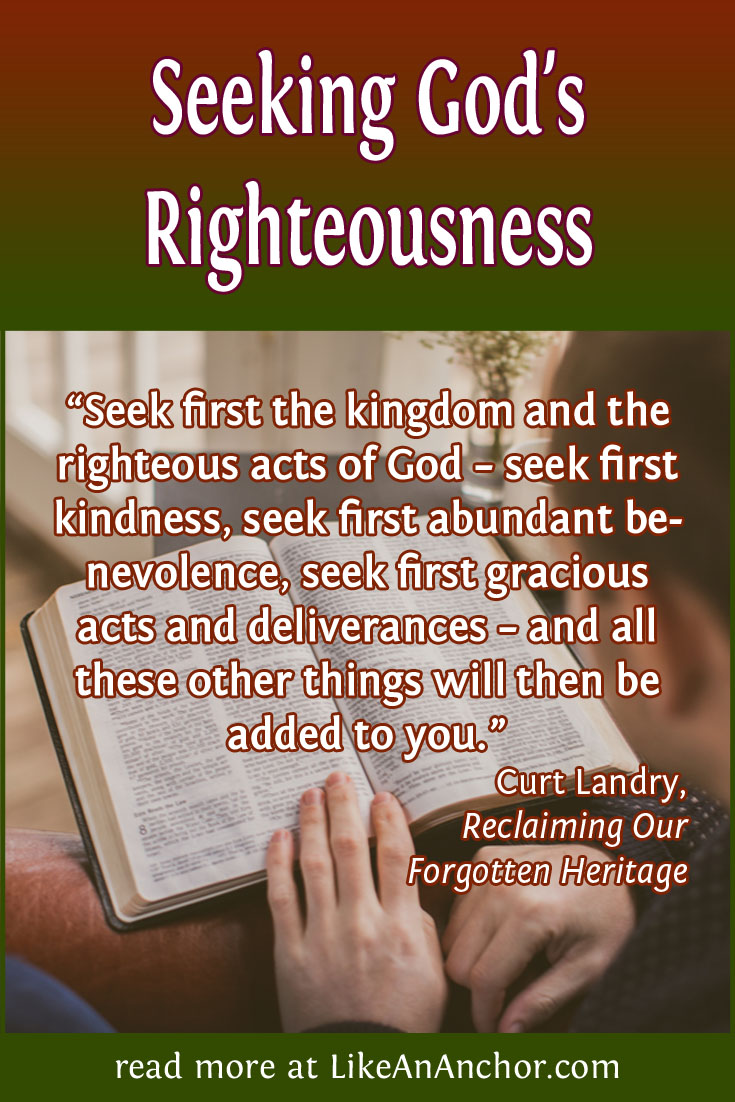
From this Jewish perspective, then, one would better read Matthew 6:33 in this way: “Seek first the kingdom and the righteous acts of God – seek first kindness, seek first abundant benevolence, seek first gracious acts and deliverances – and all these other things will then be added to you.” Read in this way, Matthew 6:33 requires a daily walk of faith that still challenges me to this day. (Landry, p. 134).

Seeking God's Righteousness | LikeAnAnchor.com
Photo credit: Pearl via Lightstock

Doing and Believing

It might not sit well with many American Christians that we need to do what is right in addition to believing what is right. Or, depending on exactly what you believe, it might be challenging to know that our obedience has to go beyond legal correctness. But as a deeper look into tzedakah demonstrates, true faith involves ongoing growth and change as we become more and more like God. Nothing we can do will save us — “by grace you have been saved through faith, and that not of yourselves; it is the gift of God” (Eph. 2:8, all scriptures from the WEB translation). But after we’re saved, we do take certain actions in accordance with God’s ways — “faith, if it has no works, is dead in itself” (James 2:17).

He has shown you, O man, what is good. What does Yahweh require of you, but to act justly, to love mercy, and to walk humbly with your God? (Micah 6:8)

Jesus called justice, mercy, and faith “the weightier matters of the law” (Matt. 23:23). These are things which must not be left undone by God’s people. And though righteousness isn’t on this list, it is closely associated with mercy and justice (see Ps. 33;5; 889:14; Is. 16:5; Hos. 2:19). We’re supposed to become like God and since righteousness is part of His character it should be part of ours as well.

Yahweh, Our Righteousness

Our God loves righteousness (Ps. 11:7; 33:5). He even reveals it as one of His names which He puts on His people — Yahweh Tsidqenu, the Lord our Righteousness (Jer. 23:6; 33:16). In the Matthew 6:33 verse we opened with, Jesus doesn’t say “seek to be righteous” or that we should seek righteousness in general. He’s very specific. We are to seek God’s righteousness.

Yahweh says, “Don’t let the wise man glory in his wisdom. Don’t let the mighty man glory in his might. Don’t let the rich man glory in his riches. But let him who glories glory in this, that he has understanding, and knows me, that I am Yahweh who exercises loving kindness, justice, and righteousness in the earth, for I delight in these things,” says Yahweh. (Jer. 9:23-24)

Knowing God involves understanding that He exercises and loves righteousness. If we want to be righteous as He is, we need to come to Him. He will reveal His righteousness when we follow His ways and keep seeking Him, as Jesus told us to in Matthew 6:33 (Is. 54:17; 56:1; 61:10).

Pursue His Righteousness

Seeking God's Righteousness | LikeAnAnchor.com
Photo credit: Anggie via Lightstock

Returning to the idea that righteousness involves more than just law-based obedience, Jesus taught “that unless your righteousness exceeds that of the scribes and Pharisees, there is no way you will enter into the Kingdom of Heaven” (Matt. 5:20). He said this during the same sermon where He told us, “seek first God’s Kingdom and his righteousness.” Seeking righteousness is a foundational part of our faith, and yet the most scrupulously obedient religious elite of Jesus’ day didn’t practice God’s righteousness in a way that pleased Him. There is more to it than simply following rules.

We aren’t saved based on how well we measure up to God’s just laws. Jesus Christ died for us “so grace might reign through righteousness to eternal life” (Rom. 5:21). As we talked about earlier, God’s type of righteousness has to do with His kindness and benevolence — righteous acts that spring from His righteous character. His righteousness toward us isn’t about legal justification based on us already being perfect, but rather about bringing us into a right state with Him and empowering us to follow His example of righteous doing (Rom. 3:21-31).

Through Christ, we have “become the righteousness of God” (2 Cor. 5:21). We’re to be “filled with the fruits of righteousness, which are through Jesus Christ, to the glory and praise of God” (Phil. 1:11). Righteousness isn’t just passively applied, though. We must “follow after righteousness” (1 Tim. 6:11; 2 Tim. 2:22) and seek God’s “instruction in righteousness” from scripture (2 Tim. 3:16; Heb. 5:13). To quote Curt Landry again, seeking first God’s kingdom and His righteousness “requires a daily walk of faith” that challenges each of us today.

Featured image credit: Pearl via Lightstock

5 Things Introverts Do That Might Seem Normal to Them, but Are Actually Rude or Annoying

The introvert possibility movement has been a wonderful thing for quiet people. Finally, we introverts are being seen as people with their own unique gifts and talents rather than a “broken” extroverts.

It has also had some unintended negative effects, though. One of these is that some (though of course not all) introverts use their introverted nature to excuse behaviors that most people actually consider rude or annoying. I’ve done it myself from time to time. But it’s not a good things and I really think we should stop.

I hesitated to write this post because so many introverts have been wrongly accused of being rude simply because people misinterpret our introverted natures. We talked about that in a post earlier this week, “5 Things Introverts Do That Might Seem Rude to Others, but Are Actually Normal For Us.” But setting that aside, there are certain things that some introverts do that really can be rude or annoying and which we use our introverted nature as an excuse for. Let’s take a look at five of them.

1) Refusing To Small Talk

I know, I know — introverts hate small talk because it creates barriers between people. Well guess what? Most people hate spending all their time on small talk. But they also recognize that small talk is an important step in relationships and there are times when refusing to engage in small talk is just plain rude. Read more