What If We Stopped Trying To Impress People?

I like to keep the people around me happy. I want harmony in all my relationships, and I hate conflict. Take all those (along with a few other personality traits and some insecurities) together, and you end up with someone who’s been a “people pleaser” for most of her life.

It’s normal for FJ personality types to act based on what will meet everyone’s needs and work to maintain harmonious relationships. That’s because they use Extroverted Feeling, or “Harmony,” as their decision-making process. But at some point in their personal growth journey, FJs need to realize that 1) you’re part of the “everyone” whose needs should be met, and 2) it’s impossible to please everyone.

Since writing my post “Are You Ready To Find Your Weirdness?” I’ve been thinking about what effect embracing authenticity will have on interpersonal relationships. One of the things I’ve realized is that instead of trying to adjust my presentation of myself to impress specific people, I need to focus more on bringing my best self to every conversation and interaction. If they’re impressed by that, cool, but if not it’s okay. Failing to please everyone isn’t really failure at all. It’s just something that happens.

We Can’t Please Everyone

It’s impossible to connect with everyone unless you’re adjusting yourself to please them. There’s far too much variety in human beings’ beliefs and preferences for your authentic self to resonate equally well with every person. In fact, if we’re being honest, I’m sure there are some types of people you don’t really want to resonate with. For example, you’d probably worry about yourself if a Klu Klux Klan member felt that you understood and agreed with them 100%. Read more
5 Tips For Resolving Conflicts Between FJ and TJ Types

Have you ever witnessed, or been part of, a conversation that starts to turn into a conflict because both parties feel the other just doesn’t “get it”? They’re approaching whatever topic they’re discussing from different perspectives, seeking different outcomes, and/or phrasing things in a way that makes sense to them but for some reason sets the other on edge.

If you talk with one of them after this conversation, you might hear things like, “I just can’t understand why they’re so irrational!” or “Why can’t they just tell me what they actually think?” Then if you talk with the other person you could hear, “I don’t see why they insist on stirring-up conflict” or “How dare they put me on the spot like that!”

This sort of situation often develops when Thinking and Feeling personality types clash. It’s especially noticeable among the INFJ, ISFJ, ENFJ, and ESFJ types and INTJ, ISTJ, ENTJ, and ESTJ types, since these types direct their decision-making processes outward. In other words, they interact with the outer world using their judging functions of Extroverted Feeling and Extroverted Thinking. If you’re not familiar with function theory, click here to read “The Simplest Guide to Myers-Briggs® Functions Ever.

One of my favorite applications for personality type theory is using it to better understand people who don’t see the world the same way as us. As I explained in a post a couple weeks ago, both Thinking and Feeling are considered rational functions. These two ways of decision-making use very different foundations for their rationalizations, however. And if you’re not aware of how that all works, then it can lead to quite a bit of frustration when you’re trying to have a conversation with someone who doesn’t share your type’s preferences. Read more

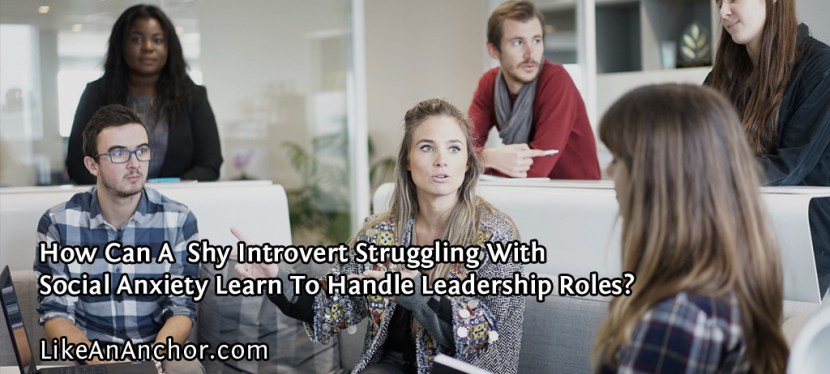
How Can A Shy Introvert Struggling With Social Anxiety Learn To Handle Leadership Roles?

I’ve never considered myself much of a leader. I like to stay out of the spotlight and play a supportive role. Part of it’s shyness/anxiety, part of it’s a normal trait of my INFJ personality type. Recently, though, I’ve found myself accidentally winding up in leadership roles.

For many introverts, especially if you’re shy and/or struggling with anxiety, this probably sounds like a recipe for a full-blown panic attack. But it’s actually going pretty well, and maybe you’ll find some of the things I’m learning encouraging if you ever find yourself in a similar situation.

It All Started With Dancing

I joined the dance team at my Messianic church several years ago, and within a year most of the dance team moved on to other things and there was just three of us left. New people quickly joined, but I suddenly found myself one of the most experienced dancers in the group. I had to keep learning quickly if I wanted to help teach, so it ended up making me a better dancer.

Then our dance leader started leaving me in charge when she had to be gone for a weekend. She even when to Alaska for a few weeks and turned keys, music files, instruction DVDs, and choice of what to dance each week over to me. I thought I’d spend most of the time panicking, but I didn’t and things went pretty well. I discovered I actually can handle being put in charge of something where I have to work with other people. Read more

5 Crucial Tips For Standing Up For Yourself As An INFJ

For many INFJs, the feeling that we don’t stand up for ourselves well enough is a frequent one. We find ourselves in uncomfortable conversations that we don’t know how to leave, or we let people cross our boundaries because we’re not sure what to say, or we don’t speak up when someone assumes something about us that isn’t true. And then we feel guilty about it, but we aren’t sure how to change.

5 Crucial Tips For Standing Up For Yourself As An INFJ | LikeAnAnchor.com
Photo credit: lavnatalia via Pixabay

For this post, we’re going to define “standing up for yourself” as sharing your ideas, choices, and opinions with others and not compromising on your personal standards, morals, or beliefs. You’re not obnoxious or dismissive of others when you “stand up for yourself” in this way, but you are honest and upfront about who you are, what you believe, and where your boundaries are.

Some people reading this, including some INFJs, already live their lives in the way I just described. If that’s you, then wonderful! Keep doing what you’re doing (and maybe share some tips for the rest of us in the comments). For others, standing up for yourself is a real challenge.

INFJs aren’t the only ones who deal with this either — any personality type can struggle with asserting themselves and practicing authenticity. Today, though, we’ll be focusing on INFJ-specific tips for getting comfortable with standing up for yourself. Other IN types (like INTJ or INFP) and FJ types (like ENFJ and ISFJ) might also find these tips helpful. Read more

How To Tell If An INFJ Likes You

INFJs have a reputation for being mysterious creatures. If you’re trying to figure out what an INFJ is really thinking, that reputation is somewhat justified. And judging by the number of people online asking, “How can I tell if an INFJ likes me?” it can be very difficult to figure out if an INFJ is attracted to you, especially in a romantic sense.

How To Tell If An INFJ Likes You | LikeAnAnchor.com
Photo credit: Yuriy Bogdanov via Unsplash

Even though the whole “otherworldly INFJ” thing has been blown way out of proportion in internet descriptions of the type, there are some things about INFJs that just don’t make sense to most other people. Since INFJs are the rarest type, our minds are wired to think in a fundamentally different (not better) way than the majority of the world’s population.

As a type which uses Extroverted Feeling to make decisions, INFJs are very interested in maintaining harmony in the outer world. This tends to make them very agreeable people. In groups, we can be friendly and sociable with just about everyone. However, we’re also introverts who spend a lot of time inside our own minds. We’re often reserved, private individuals, leaving many people confused about how we actually feel. In addition, many (though not all) INFJs struggle with varying levels of social anxiety and shyness which makes it even harder for us to make it clear when we like someone.

The following list of ways to tell if an INFJ likes you isn’t going to be 100% true of every INFJ. However, it does reflect general trends in the way many INFJs say that they act and think when they like someone. Read more

2018 On My Blog: Top 10 Lists

Once again the Gregorian calendar advances by one year. Sticking with tradition, I spent New Year’s Eve with my cousin and sister and now I’m using my first post of the new year to share my blogging highlights from last year.

This has been a big year for my blog. It’s got a name now, for one thing, since we went from marissabaker.wordpress.com to LikeAnAnchor.com. The number of visitors is holding pretty steady from last year, though it did go up a little.

One of my big goals for this upcoming year is to continue growing my blog, but that’s a subject for another post. Today’s post is about looking back on the most popular posts of 2018 and celebrating all you lovely people who’ve been reading my work.

Posts With The Most Traffic

All of the top posts this year are about INFJs, which isn’t really surprising. I was kinda surprised that my ENFP-INFJ relationships post is the most popular of all my posts, though. I guess I’ll put that on the list of good things that came out of my (now ended) relationship.

  1. Dating Your Mirror: ENFP and INFJ Relationships (published 11/11/2017)
  2. INFJ User Guide (published 6/20/2016)
  3. Religion and the INFJ (published 10/17/2016)
  4. Want To Date An INFJ? Here’s 15 Things We’d Like You To Know (published 9/18/2018)
  5. The Vanishing INFJ (published 11/28/2016)
  6. INFJ Dark Side (published 3/31/2014)
  7. The INFJ Stare (published 8/5/2013)
  8. Living With INFJ Guilt And Overcoming Cycles of Shame (published 11/13/2018)
  9. The Single INFJ (published 4/18/2018)
  10. How To Be Friends With An INFJ (published 10/13/2014)

Top 2018 Posts

Read more